
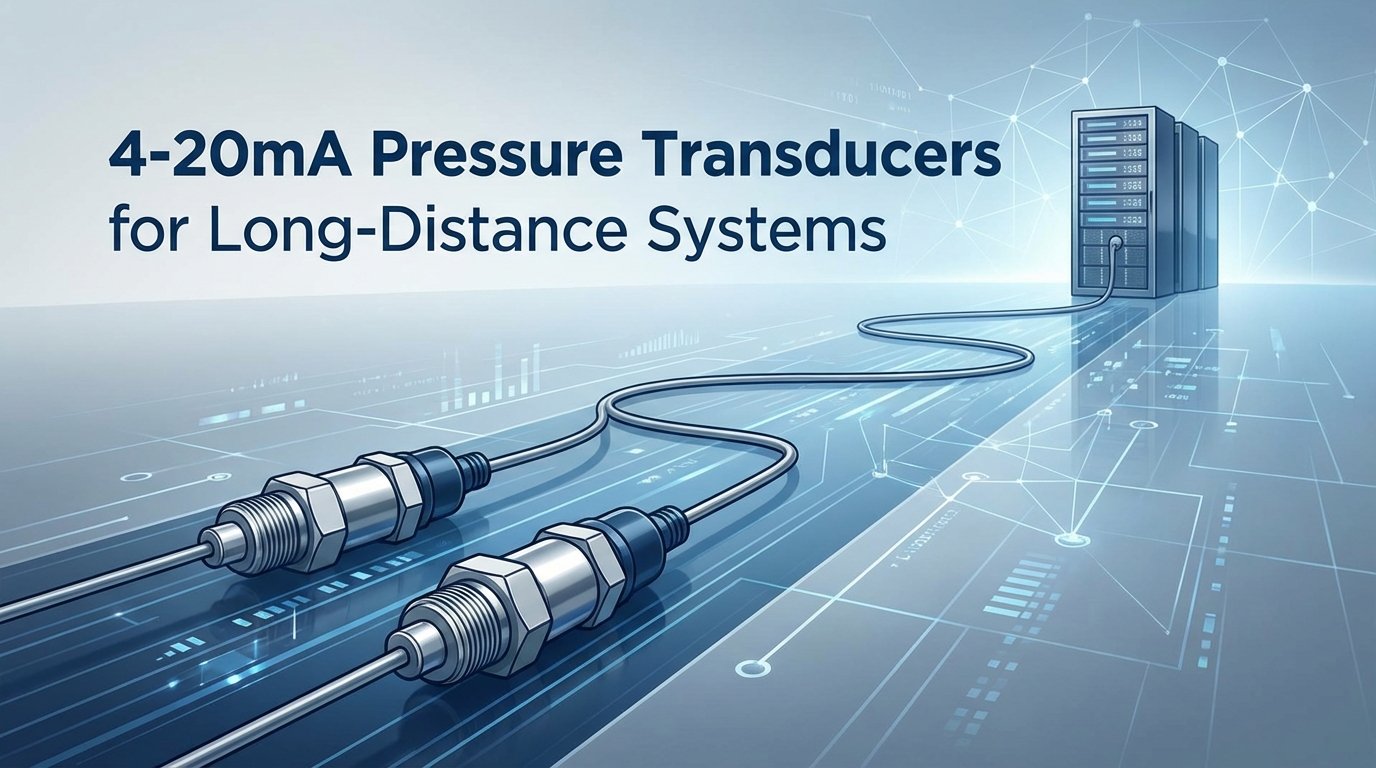
Consider a facility with pressure monitoring points spread across 800 meters. When readings turn intermittent, technicians may first suspect sensor failure, but the real cause can be signal degradation in a poorly specified digital protocol that is vulnerable to electromagnetic interference (EMI).
In 2026, despite the growth of digital communication protocols, 4–20mA current loop technology remains the most reliable solution for long-distance industrial pressure measurement.
Why 4–20mA Current Loop Technology Dominates Industrial Environments
Industrial pressure transducers using 4–20mA signaling offer clear advantages over voltage-based and digital systems in harsh conditions.
Unlike 0–10V or digital outputs, current signals are inherently resistant to voltage drop across long cable runs. Because current remains constant throughout a series circuit; regardless of cable length or resistance; measurement accuracy remains stable over hundreds or even thousands of meters.
A 4mA signal (representing zero pressure) maintains its integrity whether traveling 10 meters or 1,000 meters, provided loop resistance and supply voltage stay within specification. This is why manufacturers such as SUCO continue to rely on 4–20mA technology for demanding industrial applications.
Signal Integrity Over Long Cable Runs
Voltage signals degrade proportionally with cable resistance. A 0–10V signal transmitted over 500 meters is more vulnerable to noise and ground-potential differences, which can create substantial measurement errors.
By contrast, 4–20mA pressure transmitters regulate output current independent of loop resistance (within compliance voltage limits), ensuring stable and accurate readings even across large facilities.
For extended installations, proper voltage budgeting and careful transmitter selection are essential. Many industrial OEMs, including those working with SUCO pressure transducers, prioritize low minimum operating voltage and robust internal protection to ensure long-term reliability.
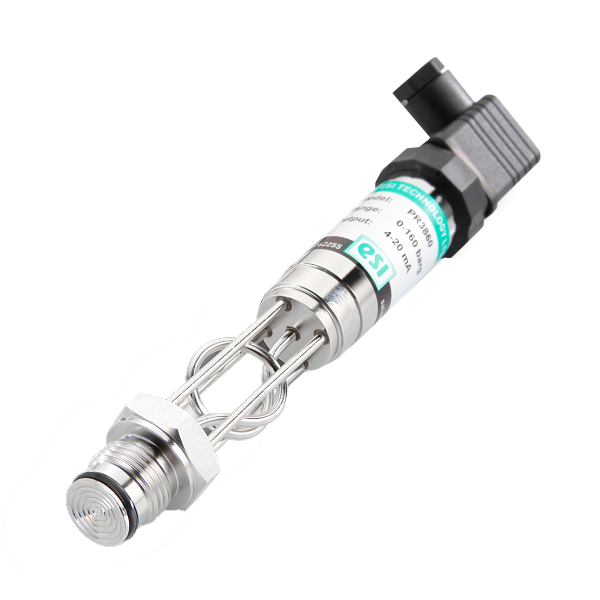
Designing 4–20mA Systems for Long-Distance Installations
Cable Selection & EMI Protection
Shielded twisted-pair cable is essential in industrial environments. Twisting reduces common-mode noise, while shielding protects against interference from:
- Variable frequency drives (VFDs)
- Welding equipment
- Heavy machinery
- Radio transmissions
Proper single-point grounding prevents ground loops and unwanted noise currents.
Loop Power Requirements
Loop-powered pressure sensors operate as two-wire devices, drawing power from the same conductors that carry the measurement signal. This reduces wiring complexity and lowers installation costs.
However, long-distance runs require careful voltage calculations. Each loop component consumes voltage:
- Transmitter operating voltage
- Cable resistance
- PLC or control input
Selecting transmitters with low minimum voltage requirements provides additional flexibility in extended installations. This approach is commonly recommended in application engineering support.

Application Examples:
Mobile Hydraulics & Construction Equipment
Construction machinery subjects pressure sensors to severe vibration, shock loads exceeding 1,000g, temperature extremes, and continuous cable flexing.
4–20mA signaling resists vibration-induced noise better than voltage or digital protocols. Combined with rugged sensing technologies, such as Silicon-on-Sapphire designs used in many SUCO pressure transducers this ensures durability and long-term stability in harsh mobile environments.
HVAC & Building Automation Systems
In commercial buildings, cable distances from rooftop equipment to control rooms often exceed 100–300 meters.
4–20mA pressure transmitters integrate directly with building management systems for:
- Pump sequencing
- Chiller optimization
- Filter monitoring
- Fire suppression pressure verification
The 4mA live-zero feature enables built-in fault detection—an important safety advantage in critical infrastructure.
Automotive Manufacturing & Test Cells
Automotive production environments combine long cable runs with high electromagnetic interference.
Industrial pressure transducers using 4–20mA output provide stable, noise-immune measurements essential for:
- Hydraulic test stands
- Pneumatic systems
- Paint process control
- Assembly tooling verification
Two-wire simplicity also supports rapid reconfiguration of manufacturing lines.

Maintenance & Troubleshooting Advantages
One of the most valuable advantages of 4–20mA pressure transducers is diagnostic simplicity.
Technicians can verify loop integrity with a standard multimeter:
- 4–20mA reading = system functioning
- 0mA = open circuit
- Out-of-range current = wiring or device fault
Unlike digital communication systems, no specialized software or configuration tools are required. This straightforward troubleshooting process is one reason 4–20mA remains the preferred output in industrial pressure measurement systems supported by companies like SUCO ESI North America.
Integration with Modern PLC, SCADA & IIoT Systems
Although 4–20mA is mature technology, it integrates seamlessly with modern automation platforms.
PLCs, DCS systems, and SCADA networks include analog input modules designed specifically for current loop signals. For IIoT applications, edge devices convert 4–20mA signals into digital protocols such as Ethernet/IP, Modbus TCP, or OPC UA at centralized points.
This hybrid approach preserves field-level reliability while enabling advanced analytics and cloud connectivity.
Selecting the Right Pressure Transducer
For long-distance industrial installations, match specifications carefully:
- Pressure Range: Select range closest to operating pressure
- Accuracy Class: ±0.5% FS typical; ±0.25% for critical processes
- Operating Temperature: Account for ambient and process extremes
- Electrical Protection: Ensure reverse polarity and surge protection
- Process Connection: Match thread and sealing requirements
- Media Compatibility: Confirm wetted material compatibility
Proper specification ensures long-term stability, measurement accuracy, and system reliability.
The Future of Industrial Pressure Measurement
As Industry 4.0 advances, reliable field instrumentation remains essential. Rather than replacing current loop systems, digital technologies increasingly build upon them.
4–20mA pressure transducers continue to provide:
- Noise immunity
- Installation simplicity
- Intrinsic reliability
- Seamless integration into digital systems
For harsh environments and long cable runs, 4–20mA remains the industrial benchmark.
Partner with SUCO North America
Selecting industrial pressure transducers for critical applications requires more than reviewing specifications. It requires engineering expertise and proven field performance.
SUCO North America supports OEMs and industrial operators with application guidance, voltage drop analysis, EMI mitigation strategies, and pressure transmitter selection tailored to demanding environments.
With decades of experience in pressure measurement technology, SUCO continues to deliver reliable, precision-engineered solutions trusted across construction, automotive, HVAC, and industrial markets.
Contact SUCO ESI North America for technical support and application assistance. We serve the US, Canada, and Latin America. Hablamos español.
Email: sales@sucoesi.com
Phone: 1-561-989-8499