

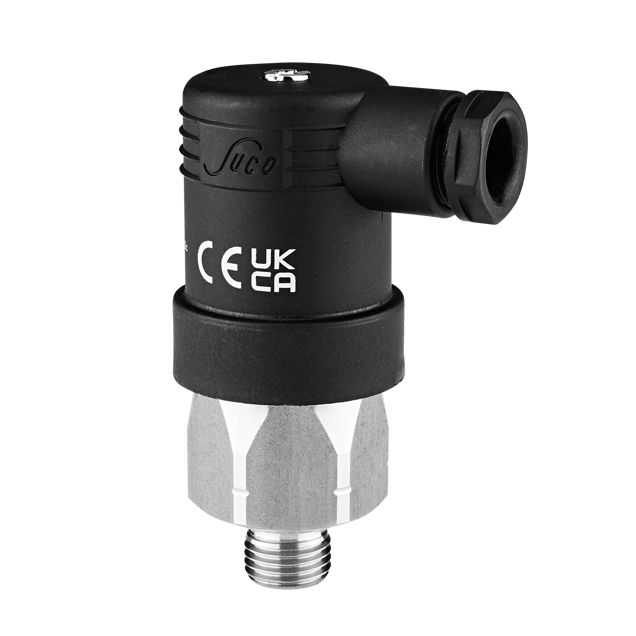
Piston pressure switches use a spring-loaded piston mechanism to open or close an electrical circuit when system pressure crosses a set threshold. They are the preferred choice for hydraulic systems, mobile equipment, and heavy industrial applications where robust mechanical actuation, high pressure ratings, and resistance to vibration and shock matter most. This guide helps engineers and procurement specialists select the right switch for demanding environments.
 Key takeaways
- Piston-actuated designs outperform diaphragm switches in high-pressure, high-vibration hydraulic applications.
- Hazardous-area certification (ATEX Explosion Proof Pressure Switch, IECEx or the applicable regional equivalent) is non-negotiable when switches operate in zones with flammable gases, vapors, or dust.
- Setpoint repeatability, hysteresis, and media compatibility are the three most critical selection criteria.
- German engineering precision underpins SUCO ESI North America’s mechanical pressure switch product line.
- Correct electrical ratings; current, voltage, switching type—must match your circuit design before any other specification.
Why Piston Actuation Still Dominates Heavy Industry
Piston pressure switches are widely used in industrial applications because they are reliable, durable, and do not need an external power supply to operate.
They can handle high pressures and sudden pressure spikes, making them a good choice for hydraulic systems, cranes, excavators, construction equipment, and oil-field machinery.
For applications that require continuous pressure readings, SUCO ESI North America also offers pressure transducers to measure pressure in real time.
Engineering note
Piston switches are built for liquid media such as hydraulic oil. SUCO’s user manuals state that piston pressure switches are not suitable for gaseous media, particularly oxygen. For compressed air or other gases, specify a diaphragm switch and check that model’s manual for any oxygen limits.
Key Selection Criteria
 1. Pressure Range and Setpoint Accuracy
The switch must be specified for the maximum system pressure it will see, not just the normal operating range. Industrial hydraulic circuits regularly generate transient spikes that can be two to three times the nominal working pressure. A switch rated at or below the spike pressure will suffer premature wear or mechanical failure.
Setpoint repeatability—how consistently the switch trips at the same pressure across thousands of cycles—is equally critical. Tight repeatability reduces nuisance trips and prevents delayed shutdowns in protective circuits. When reviewing datasheets, look for stated repeatability figures tied to actual test conditions, not just nominal setpoint values.
2. Switching Differential (Hysteresis)
Hysteresis is the pressure gap between the make and break points of the switch. Too narrow, and the switch will chatter under fluctuating pressure; too wide, and the controlled system will overshoot significantly before the switch resets. For most hydraulic applications, a moderate hysteresis that prevents rapid cycling without allowing large pressure excursions is the engineering target.
3. Media Compatibility
The wetted parts of a piston switch—seals, piston material, body material—must be chemically compatible with the process fluid. Hydraulic oil, water-glycol mixtures, and aggressive process chemicals each demand different seal materials. Nitrile works well for petroleum-based fluids; EPDM or PTFE may be required for water-based or chemical media. Always confirm compatibility before installation.
| Selection Criterion | Piston Switch | Diaphragm Switch |
|---|---|---|
| High-pressure suitability | Excellent | Limited |
| Vibration and shock resistance | High | Moderate |
| Pressure spike tolerance | High | Lower |
| Low-pressure sensitivity | Moderate | High |
| Viscous media handling | Good | Can be limited |
4. Electrical Ratings
Current and voltage ratings of the internal switch contacts must match the load they will switch. Inductive loads—solenoid valves, motor starters—require derated contact ratings compared to resistive loads. Verify AC versus DC rating separately; a switch rated for 10 A AC may carry a significantly lower DC rating due to arc suppression differences. This is one of the most frequently overlooked specification points in industrial procurement.
5. Connection and Housing
Process connections—NPT, BSP, SAE, or metric—must match your plumbing standard. Housing ingress protection (IP rating per IEC standards) determines suitability for wash-down, outdoor, or submerged installations. For cable entry, confirm the conduit size and thread type match the electrical installation on site.
ATEX Compliance: When It’s Mandatory and Why It Matters
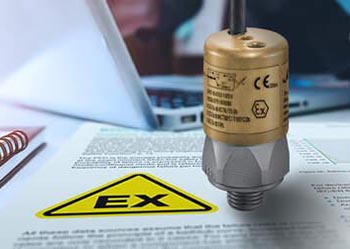
 Any pressure switch installed in a classified hazardous area—Zone 0, 1, or 2 for gases; Zone 20, 21, or 22 for dusts; must carry the correct ATEX or IECEx certification for that zone and equipment group. This is not a specification preference; it is a legal and safety requirement in facilities that fall under hazardous area classification regulations.
The ATEX Directive 2014/34/EU governs equipment placed on the market for use in explosive atmospheres in the European Union, and equivalent IECEx standards apply in many international markets including oil and gas operations worldwide. North American operations working to NEC Article 500 classifications should verify which certification framework their facility and customer contracts require.
SUCO ESI North America offers ATEX-certified piston pressure switches for these environments: the explosion-proof 0345 and 0387 and the intrinsically safe 0391, 0393 and 0397. Each datasheet lists the zones that model is approved for. Selecting a non-certified switch to save cost in a classified zone is an engineering liability and a safety failure—not a tradeoff.
Safety warning
Installing a non-ATEX-certified switch in a classified hazardous area may void your facility’s insurance, breach regulatory compliance, and create genuine ignition risk. Always verify zone classification before specifying any switching device.
Selecting a non-certified switch to save cost in a classified hazardous area is an engineering liability and a safety failure—not a tradeoff.

Specify the Right Pressure Switch for Your Application
SUCO ESI North America’s engineering team can help you select, configure, and document the right mechanical pressure switch for hydraulic systems, hazardous area installations, and demanding OEM equipment—backed by German engineering precision and ATEX certification expertise.
Industrial Applications Where Piston Switches Perform
Mobile Hydraulics and Construction Equipment
Excavators, wheel loaders, cranes, and agricultural machinery subject pressure switches to constant vibration, shock, and wide temperature swings. Piston switches mounted directly on hydraulic circuits monitor implement pressure, brake circuits, and steering systems. Their mechanical robustness means they continue operating correctly when electronic sensors might struggle with connector corrosion or vibration-induced failures.
Industrial Machinery and Presses
Hydraulic presses, injection molding machines, and metal forming equipment use pressure switches as both process monitors and safety interlocks. The switch trips when clamping pressure reaches setpoint, confirms circuit integrity before a cycle begins, and shuts down the machine if pressure drops unexpectedly. In safety interlock service, repeatability and fail-safe switching mode (normally open vs. normally closed) are critical design decisions.
For applications where the switching function needs to be supplemented by continuous pressure data for process optimization, engineers often pair a mechanical switch with a pressure transducer on the same circuit branch—each device doing what it does best.
The SUCO ESI North America Advantage
SUCO ESI North America’s mechanical pressure switches are designed and manufactured in Bietigheim-Bissingen, Germany. The product line covers a broad range of pressure ratings, housing materials, electrical configurations, and connection standards to serve OEM designers and end-user facilities across oil and gas, construction, industrial machinery, and cooling applications.
What differentiates a well-specified switch from a commodity part is the engineering support behind it. Setpoint calibration, material selection for aggressive media, and ATEX certification documentation all require product knowledge that goes beyond a datasheet. SUCO ESI North America’s technical team works directly with engineers to configure switches that fit the application—not the other way around.
For applications requiring continuous output signals rather than discrete switching, SUCO’s electronic pressure switches offer programmable switching points, and the menu-controlled 0570 adds an analogue output alongside its two switching outputs.
1
Define your pressure range
Establish normal operating pressure and maximum expected spike pressure. Size the switch above the spike ceiling, not just the nominal range.
2
Classify the installation environment
Confirm hazardous area classification, IP rating requirements, and temperature range for the installation location.
3
Specify media compatibility
Identify the process fluid, operating temperature, and any chemical aggressiveness that affects seal and body material selection.
4
Confirm electrical requirements
Match switch contact ratings to load type (resistive or inductive), current, and voltage. Specify NO or NC contact configuration for the control logic.
5
Consult engineering support
For ATEX certification requirements, custom setpoints, or non-standard configurations, work directly with SUCO ESI North America’s technical team before ordering.
Frequently Asked Questions
What is the difference between a piston pressure switch and a diaphragm pressure switch?
A piston switch uses a spring-loaded piston that moves against system pressure to actuate an electrical contact. A diaphragm switch uses a thin flexible membrane. Piston designs handle higher pressures, tolerate pressure spikes better, and perform reliably in high-vibration environments. Diaphragm switches tend to offer greater sensitivity at low pressures but are more vulnerable to overpressure damage.
When does an industrial pressure switch require ATEX certification?
In the EU, ATEX certification is required whenever a switch is installed in a classified hazardous area—any location where flammable gases, vapors, or combustible dust may be present in concentrations that could ignite. This includes petroleum processing facilities, chemical plants, grain handling operations, and many oil and gas installations. Other markets use IECEx or national schemes, such as NEC hazardous location classifications in North America. Zone classification must be completed before specifying any electrical device for the location.
How do I choose the correct switching differential (hysteresis) for my hydraulic system?
Hysteresis should be wide enough to prevent rapid contact cycling under normal pressure fluctuations, but narrow enough to allow the controlled system to reset close to the setpoint. For most hydraulic circuits, this is an application-specific calculation based on system volume, pump characteristics, and the acceptable pressure band. Consulting the switch manufacturer’s technical team is the most reliable way to confirm the correct differential for a specific circuit.
Can I use a mechanical pressure switch and a pressure transducer on the same circuit?
Yes, and this is a common configuration in process and industrial machinery applications. The mechanical switch handles discrete control and safety interlock functions—no power required, direct switching action. The pressure transducer provides continuous analog output for monitoring, data logging, or process control. They serve different functions and are not interchangeable, but they work together effectively on the same hydraulic or pneumatic circuit branch.
What media can piston pressure switches handle?
Piston switches are used with liquid media such as petroleum-based hydraulic fluids, water-glycol mixtures, and many industrial process fluids—depending on seal and body material selection. SUCO’s user manuals state that piston pressure switches are not suitable for gaseous media, particularly oxygen, so compressed air and other gases call for a diaphragm switch. Chemical compatibility of all wetted components must be verified for the specific fluid before installation. Contact SUCO ESI North America’s engineering team for guidance on aggressive or non-standard media.
Specify the Right Pressure Switch for Your Application
SUCO ESI North America’s engineering team can help you select, configure, and document the right mechanical pressure switch for hydraulic systems, hazardous area installations, and demanding OEM equipment—backed by German engineering precision and ATEX certification expertise.

About SUCO ESI North America
SUCO ESI North America, part of the SUCO Group, supplies mechanical and electronic pressure switches designed and manufactured in Bietigheim-Bissingen, Germany, and ESI pressure transducers manufactured in Wrexham, UK, to industry across the U.S., Canada, Mexico and Latin America — including mobile hydraulics, construction, HVAC and refrigeration, industrial automation, oil & gas, aerospace and defense. From its St. Louis center it provides product selection support, same-day setpoint calibration and shipping for in-stock switches, and next-day delivery across North America. Visit sucoesi.com →