
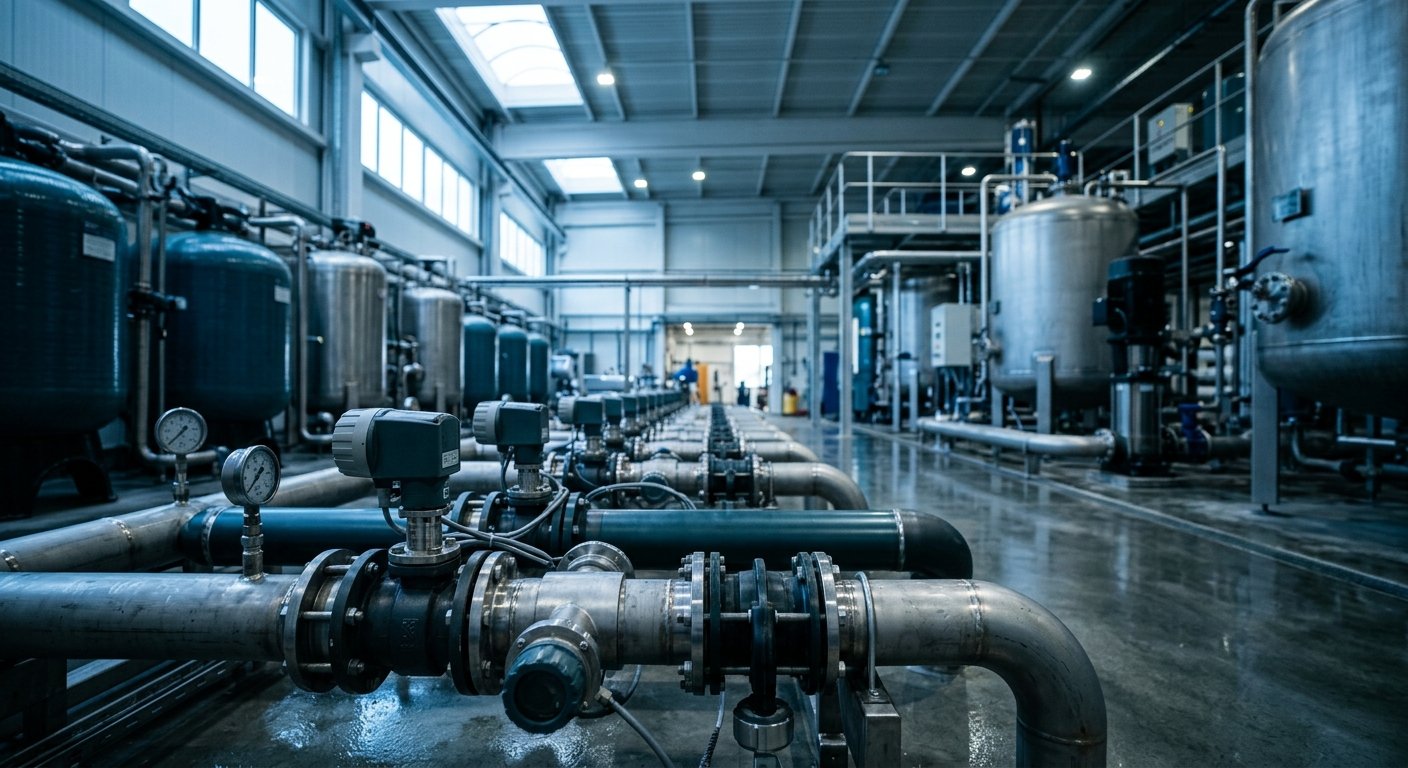
Choosing the right pressure switch for water and wastewater applications requires matching more than a pressure range. Chemical compatibility, duty cycle, ingress protection, and regulatory certifications all determine whether a switch lasts years or fails within months. Distribution networks typically run at 40–80 PSI; wastewater environments add corrosive media, hydrogen sulfide, and variable pH—making material and type selection consequential for public health and regulatory compliance.
- Water and wastewater systems operate 24/7 at 40–80 PSI, demanding switches rated and sized for the middle third of their pressure range—not just above the maximum.
- Mechanical switches are proven for pump control; electronic switches add programmable setpoints, higher cycle life, and SCADA communication.
- Wetted materials must match the actual chemical environment: NSF/ANSI 61 certification for potable water, 316L stainless and EPDM seals where chlorine compounds are present.
- A dead band of 15–20 PSI is appropriate for most municipal pump control applications; too small a dead band causes short-cycling and motor burnout.
- IP67 minimum ingress protection is required for outdoor pump stations and wet wells; ATEX/IECEx certification applies where biogas is produced.
A pump that fails to start, a valve that doesn’t close on time, or a system that over-pressurizes without warning—these aren’t just operational inconveniences. They’re the kind of failures that shut down service to thousands of people and trigger regulatory scrutiny. At the center of preventing those failures is a component that rarely gets enough attention during design reviews: the pressure switch.
This guide breaks down what you need to know—from selection criteria to common mistakes—so your system runs reliably whether you’re managing a municipal water distribution network or an industrial wastewater treatment plant.
Why Pressure Switch Selection Is More Complex Than It Looks
Water and wastewater environments are deceptively demanding. On the surface, water seems harmless. But treated drinking water systems operate under strict pressure regulation—typically between 40 and 80 PSI for distribution networks. Wastewater systems, on the other hand, deal with corrosive media, suspended solids, hydrogen sulfide gas, and varying pH levels that can degrade standard switch materials within months.
Add in the fact that these systems operate 24/7, and the cost of choosing the wrong pressure switch becomes clear. A failed switch in a pump station could mean flooding, equipment damage, or a compliance violation with your state environmental agency.
Before selecting any pressure switch, engineers should ask three questions:
- What media will the switch contact directly?
- What are the process pressure ranges and acceptable dead band tolerances?
- What happens if the switch fails open or closed?
The answers drive every specification decision that follows.
Understanding the Two Core Types of Pressure Switches
There are two fundamental types used in water and wastewater systems, each with distinct advantages depending on the application.
Mechanical Pressure Switches
Mechanical switches use a physical sensing element—typically a diaphragm, piston, or bellows—that deflects under pressure and actuates an electrical contact. They’re proven, cost-effective, and require no external power for the sensing function itself.
In water pump control applications, mechanical pressure switches have been the industry standard for decades. A well pump pressure switch, for example, cuts power to the pump when the system reaches a set pressure (typically 60 PSI) and restores it when pressure drops to a lower cut-in point (typically 40 PSI).
The limitation? Mechanical switches have moving parts that wear over time, limited adjustability, and can be sensitive to water hammer—a common issue in municipal distribution systems where sudden valve closures create pressure spikes.
Electronic Pressure Switches
Electronic pressure switches use solid-state sensing technology to detect pressure changes and trigger digital or relay outputs. They offer programmable setpoints, diagnostics, and significantly higher cycle life than their mechanical counterparts.
For modern wastewater treatment facilities integrating SCADA systems, electronic pressure switches provide the communication capabilities and precision that legacy mechanical switches simply can’t match. They’re particularly valuable in lift stations and chemical dosing systems where tight pressure tolerances improve process efficiency.
| Criterion | Mechanical | Electronic |
|---|---|---|
| Sensing element | Diaphragm, piston, or bellows | Solid-state sensor |
| Setpoint adjustability | Limited | Fully programmable |
| Cycle life | Good | Significantly higher |
| SCADA / PLC integration | Not supported | Yes — digital/relay outputs |
| Water hammer sensitivity | Higher | Lower |
| Best fit | Pump control, proven applications | Lift stations, chemical dosing, tight tolerances |
Understanding the trade-offs between these two types is essential. For a deeper technical comparison, this breakdown of mechanical vs. electronic pressure switches covers the decision criteria in detail.
Material Compatibility: The Factor Most Engineers Underestimate
Material selection is where pressure switch specifications often go wrong in water and wastewater environments. The wetted materials—the parts that contact the process media—must be chemically compatible with everything the system carries.
Standard 304 stainless steel performs well in clean water applications. But in wastewater environments with elevated chloride concentrations or chemical disinfection byproducts, 316L stainless steel or specialty alloys may be required. Similarly, EPDM or FKM diaphragm materials offer better resistance to the chlorine compounds commonly used in water treatment than standard NBR.
In potable water systems, specifying the wrong wetted materials doesn’t just cause premature failure—it can leach contaminants into drinking water and create serious public health liability. NSF/ANSI 61 certification is the baseline requirement for any component in direct contact with potable water.
Key material considerations by application type:
- Potable water systems: NSF/ANSI 61 certified materials, 316L stainless, EPDM seals
- Wastewater lift stations: Corrosion-resistant housing, IP67 or IP68 ingress protection, high-cycle diaphragms
- Chemical treatment systems: Confirm compatibility with specific dosing chemicals (sodium hypochlorite, ferric chloride, etc.)
- Sludge handling: Wide-port connections to resist clogging, flush diaphragm designs
Pressure Ranges, Dead Band, and Process Accuracy
Matching the pressure range sounds simple—but it’s more nuanced than picking a switch rated above your maximum operating pressure.
The switch should be selected so that normal operating pressure falls in the middle third of its rated range. Operating at the extremes of a switch’s range accelerates wear and reduces accuracy. For a system running at 60 PSI, a switch rated to 150 PSI gives a better, longer-lasting result than one rated to 75 PSI.
Too small a dead band causes rapid cycling, which burns out pump motors; too large a dead band allows pressure to drop too far before the pump restarts, potentially causing system starvation.
Dead band—the pressure differential between the cut-in and cut-out points—matters especially in pump control applications. In most municipal water systems, a dead band of 15 to 20 PSI is appropriate. Electronic pressure switches allow precise dead band programming, which is a significant advantage when process requirements are tight.
Common Mistakes That Lead to Premature Failure
Some of the most common pressure switch failures in water and wastewater systems are entirely preventable. The issues generally fall into a few categories:
- Incorrect IP rating: Outdoor pump stations and wet wells demand IP67 minimum. Standard enclosures fail quickly in these environments.
- Ignoring water hammer: Pressure transients can far exceed system operating pressure. A switch rated to 100 PSI in a 60 PSI system can still fail from repeated 200 PSI spikes if water hammer isn’t addressed.
- Wrong process connection: Standard threaded connections can clog in sludge applications. Flush diaphragm or remote seal configurations are often better choices.
- Overlooking hysteresis requirements: Failing to account for the required dead band leads to pump short-cycling and premature motor failure.
Water hammer events are one of the most common hidden causes of pressure switch failure. After any significant hydraulic event—rapid valve closure, pump trip, or system surge—inspect and calibration-check any switch in the affected pressure zone before returning the system to normal service.
For a complete list of selection errors, this guide on critical pressure switch selection mistakes is worth reviewing before finalizing any specification.
Certifications and Compliance in Water and Wastewater
Depending on the facility type, pressure switches may need to meet specific regulatory or safety standards. For potable water contact applications, NSF/ANSI 61 certification ensures materials won’t contaminate drinking water. For chemical storage and handling areas within treatment plants, ATEX or IECEx certification may be required if flammable gases are present—particularly in anaerobic digestion facilities that produce biogas.
Pump stations with remote monitoring increasingly require pressure switches with specific electrical certifications for integration with PLCs and SCADA systems. Verifying UL listing or CE marking ensures the device meets baseline electrical safety requirements in your jurisdiction.
It’s also worth noting that pressure switches and pressure transducers serve different roles in these systems. Pressure switches trigger discrete on/off actions; transducers provide continuous analog output for monitoring and data logging. Using one where the other is required creates system design problems. For clarification on when each is appropriate, this resource on pressure sensors vs. switches vs. transducers clarifies the distinctions clearly.
Frequently Asked Questions
What is a pressure switch for water?
A water pressure switch is an electromechanical or electronic device that monitors system pressure and opens or closes an electrical circuit when pressure reaches a defined setpoint. In residential and municipal water systems, they’re primarily used to control pump operation—starting the pump when pressure drops below a minimum threshold and stopping it when pressure reaches the upper limit.
What are two types of pressure switches?
The two primary types are mechanical pressure switches and electronic pressure switches. Mechanical switches use a physical sensing element (diaphragm, piston, or bellows) that actuates a contact when pressure reaches a setpoint. Electronic pressure switches use solid-state sensors and digital circuitry to detect pressure changes, offering programmable setpoints, higher cycle life, and communication capabilities for modern control systems.
What are some common applications of pressure switches in water and wastewater systems?
Common applications include pump start/stop control in water distribution systems, high-pressure and low-pressure alarms in treatment plants, level monitoring in wet wells and storage tanks (via pressure measurement at the tank bottom), flow detection in distribution networks, and process protection in chemical dosing systems. Lift station pump control is one of the most demanding applications due to continuous cycling and aggressive media exposure.
What happens when a water pressure switch goes bad?
A failing pressure switch typically causes one of three problems: the pump won’t start (switch contacts stuck open), the pump runs continuously without shutting off (contacts stuck closed), or the system cycles rapidly because the switch is losing its setpoint accuracy. In municipal systems, a failed switch can trigger alarms, cause pressure zone failures, or lead to pump motor burnout from short-cycling. Regular inspection and calibration checking—especially after water hammer events—helps catch deterioration early.
Making the Right Choice for Long-Term Reliability
Pressure switch selection for water and wastewater applications requires more engineering judgment than most other industries. The combination of continuous operation, corrosive media, strict regulatory requirements, and the public health consequences of failure makes every specification decision consequential.
The right approach starts with clearly defining the process conditions—media composition, pressure range, cycle frequency, and environmental exposure—before evaluating any product. Match materials to the actual chemical environment, not just the primary fluid. Size the pressure range for the middle of the operating window. Specify appropriate ingress protection for the installation location.
Define process conditions
Document media composition, operating pressure range, cycle frequency, and environmental exposure before opening any product catalog.
Match materials to the chemical environment
Select wetted materials—316L stainless, EPDM, FKM—based on the actual chemicals present, not just the primary fluid. Confirm NSF/ANSI 61 certification for potable water contact.
Size the pressure range correctly
Normal operating pressure should fall in the middle third of the switch’s rated range. For a 60 PSI system, a 150 PSI-rated switch outperforms a 75 PSI unit in longevity and accuracy.
Set the dead band appropriately
Target 15–20 PSI dead band for most municipal pump control applications. Use an electronic switch where tighter or programmable dead band is required.
Verify certifications for the installation type
Confirm IP67 minimum for wet wells and outdoor stations, NSF/ANSI 61 for potable water, and ATEX/IECEx where biogas or flammable gases may be present.
At SUCO ESI North America, our engineering team has supported water and wastewater applications across municipal utilities, industrial treatment systems, and process plants. We help instrumentation engineers and procurement teams navigate the technical requirements and select pressure switches built for long service life in demanding environments.
Get expert guidance on your pressure switch specification
Tell us your application conditions and our engineering team will recommend solutions built for how your system actually operates—not just laboratory conditions.

About SucoESI
SucoESI is an industrial pressure measurement technology specialist serving oil & gas, aerospace, construction, and emerging hydrogen technology sectors. With German engineering precision and expertise in extreme environments and hazardous area compliance, the company provides reliable pressure switches, transducers, and sensors for demanding applications. Their solution-focused approach emphasizes technical customization, safety compliance, and expert support for engineering professionals and technical decision-makers who prioritize long-term reliability over cost. Visit sucoesi.com →