
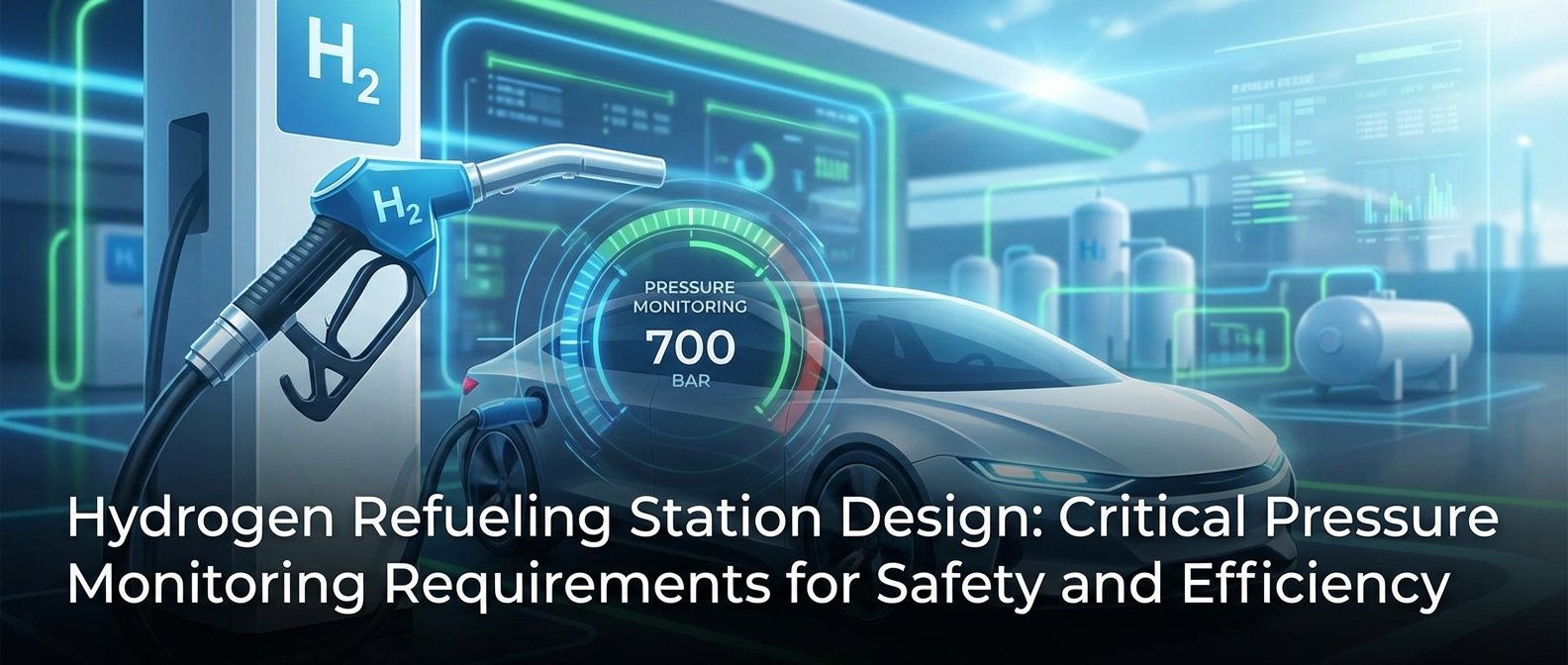
Hydrogen Refueling Station Design: Critical Pressure Monitoring Requirements for Safety and Efficiency
The hydrogen economy is rapidly maturing in 2026, with refueling stations expanding across industrial corridors and urban centers. Yet hydrogen’s unique properties—operating pressures reaching 1,000 bar (14,500 psi), extreme temperature fluctuations during compression, and the smallest molecular size of any element—create unprecedented challenges for pressure monitoring systems. A single sensor failure at a hydrogen refueling station can trigger cascading safety incidents, operational shutdowns costing thousands per hour, and regulatory violations that jeopardize licensing.
Designing effective pressure monitoring architecture for hydrogen infrastructure demands more than conventional industrial instrumentation. Engineers must navigate explosive atmosphere classifications, hydrogen embrittlement risks, fast-fill protocol requirements, and multi-stage pressure regulation—all while maintaining measurement accuracy within ±1% across temperature swings of 100°C or more.
Understanding Hydrogen’s Unique Measurement Challenges
Hydrogen presents measurement difficulties that fundamentally differ from traditional compressed gases. Its molecular diameter of just 0.1 nanometers enables permeation through materials that contain larger molecules effectively. At refueling station pressures—typically 350 bar for commercial vehicles and 700 bar for passenger applications—hydrogen atoms infiltrate metal crystal structures, causing embrittlement that compromises structural integrity over time.
Temperature management adds another layer of complexity. The compression process generates significant heat, while the Joule-Thomson effect during vehicle tank filling can drop temperatures to -40°C within seconds. Hydrogen pressure sensors must maintain calibration stability through these thermal cycles while their wetted materials resist both embrittlement and thermal stress cracking.
The explosive nature of hydrogen-air mixtures between 4-75% concentration requires all electrical equipment in Zone 1 and Zone 2 classified areas to meet stringent ATEX and IECEx certification requirements. Traditional pressure sensors with organic sealing materials or designs prone to leak paths become unacceptable risks in this environment.
Critical Pressure Monitoring Points in Refueling Architecture
Compression and Storage Systems
The compression train represents the first critical monitoring zone. Multi-stage compressors elevate hydrogen from delivery pressure (typically 200-500 bar from tube trailers or pipeline feeds) to storage pressure of 900-1,000 bar. Each compression stage requires pressure monitoring for:
- Interstage pressure control: Optimizing compression efficiency and preventing stage overload
- Discharge temperature correlation: Detecting abnormal compression behavior indicating mechanical issues
- Emergency shutdown triggering: Rapid response to over-pressure conditions before relief valve activation
- Compressor performance trending: Predictive maintenance scheduling based on pressure ratio degradation
High-pressure storage cascades maintain hydrogen inventory for rapid vehicle fills. These buffer systems typically employ three pressure banks (low, medium, high) with hydrogen safety pressure switches protecting each vessel against over-pressure while continuous transmitters provide inventory management data to the station control system.
Dispenser and Vehicle Interface
The dispensing sequence demands the most sophisticated pressure monitoring in the entire station. Fueling protocols defined by SAE J2601 and ISO 19880-1 require precise pressure ramping to fill vehicle tanks safely while minimizing time. Hydrogen refueling station sensors at the dispenser must deliver:
- Real-time pressure feedback: Control loop response times under 50 milliseconds for accurate fill profile execution
- Vehicle tank pressure estimation: Calculating actual tank conditions from nozzle pressure and temperature data
- Safety interlock confirmation: Verifying nozzle connection integrity before enabling flow
- Fill termination accuracy: Detecting target pressure achievement within tight tolerances
Temperature-compensated h2 pressure monitoring at the dispenser nozzle is essential because the temperature differential between ambient conditions and cold hydrogen during fast-fills significantly affects pressure readings. Sensors lacking adequate temperature compensation can cause premature fill termination (underfilling) or delayed cutoff (overfilling)—both creating customer satisfaction issues and potential safety concerns.
Pre-Cooling and Thermal Management
Many stations incorporate pre-cooling systems that chill hydrogen to -20°C or lower before dispensing, enabling faster fills without exceeding vehicle tank temperature limits. The refrigeration circuit requires pressure monitoring for refrigerant systems, while the hydrogen path needs sensors that maintain accuracy across the full thermal range from ambient storage temperature through chilled dispensing conditions.
Sensor Technology Selection for Hydrogen Service
Material compatibility forms the foundation of reliable fuel cell pressure measurement in hydrogen applications. Austenitic stainless steels like 316L provide baseline resistance, but wetted component design must eliminate elastomeric seals in high-pressure zones where hydrogen permeation and explosive decompression can destroy polymer materials.
Silicon-on-Sapphire (SOS) sensor technology offers distinct advantages for hydrogen refueling applications. The sapphire diaphragm provides exceptional chemical resistance and hydrogen impermeability while maintaining measurement stability across temperature extremes. Unlike traditional strain gauge or thin-film sensors on metal substrates, SOS construction eliminates concerns about hydrogen diffusion into the sensing element—a critical reliability factor for long-term accuracy in hydrogen service.
All-welded construction with metal sealing technology ensures leak-tight integrity at molecular scale. The German engineering approach employed by manufacturers with extensive hydrogen application experience prioritizes designs that eliminate potential permeation paths through material selection and welded assembly rather than relying on compression fittings or elastomeric seals.
ATEX and IECEx Certification Requirements
Hazardous area classification drives equipment selection throughout hydrogen facilities. Most refueling stations classify dispenser areas as Zone 1 (explosive atmosphere likely during normal operation) with surrounding areas designated Zone 2 (explosive atmosphere possible under abnormal conditions).
Hydrogen pressure sensors installed in these zones must carry appropriate ATEX certification (for European markets) or IECEx certification (increasingly adopted globally). The most common protection concepts for pressure instrumentation include:
- Intrinsic safety (Ex ia): Limiting electrical energy to levels incapable of ignition even under fault conditions
- Flameproof enclosures (Ex d): Containing any internal ignition and preventing flame propagation to external atmosphere
- Encapsulation (Ex m): Embedding electrical components in compounds that prevent explosive atmosphere exposure
Intrinsically safe sensors offer installation flexibility since they don’t require specialized enclosures at the field device location, though they demand certified barriers or isolators in the control room to maintain the intrinsically safe circuit. This approach particularly suits transmitters requiring continuous analog or digital signals for process control.
Safety System Architecture and Redundancy
Hydrogen refueling stations typically implement safety instrumented systems (SIS) rated to Safety Integrity Level 2 (SIL 2) or higher for critical shutdown functions. Pressure monitoring provides primary inputs to these safety systems, protecting against catastrophic failures through multiple defense layers.
Redundant pressure measurement using independent sensors and transmitters guards against single-point failures. The safety system employs voting logic (typically 1oo2 or 2oo3 configurations) that continues safe operation even with one channel failure while alerting operators to the degraded condition requiring maintenance.
Hydrogen safety pressure switches provide hardwired shutdown capability independent of programmable control systems. These dedicated devices actuate emergency isolation valves and compressor shutdowns without relying on software logic, communication networks, or power supplies beyond their intrinsic circuit energy—creating an ultimate failsafe layer.
Pressure Relief Coordination
Safety relief valves protect pressure vessels throughout the station, but pressure monitoring systems must coordinate with relief devices to prevent unnecessary activation. Properly configured high-pressure alarms and automated control responses should intervene before conditions reach relief valve setpoints, avoiding hydrogen venting incidents that trigger facility evacuations and regulatory reporting requirements.
Pressure switch setpoints require careful engineering to create appropriate response hierarchies: operational high alarms triggering control system responses, high-high alarms initiating automated shutdowns, and final mechanical relief as the last protection layer. Typical spacing provides 5-10% pressure differential between these successive protection layers.
Performance Specifications for Station Applications
Hydrogen refueling applications demand specific performance characteristics beyond general industrial pressure measurement:
- Pressure range: 0-1,000 bar minimum for storage monitoring; 0-1,200 bar preferred for design margin
- Accuracy: ±0.5% full scale or better for custody transfer and fill protocol compliance
- Temperature compensation: Maintained accuracy from -40°C to +85°C without external correction
- Response time: Under 50 ms for dispensing control loops
- Long-term stability: Less than ±0.25% drift annually to minimize recalibration frequency
- Vibration resistance: 10g capability for compressor-mounted applications
- EMI immunity: Industrial electromagnetic compatibility per IEC 61326 standards
Output signal options should match station control system architecture. Analog 4-20mA remains common for simple reliable transmission, while digital protocols like Modbus RTU or IO-Link enable advanced diagnostics and configuration capabilities. Stations employing safety PLCs may require specialized safety-rated transmitter outputs certified to relevant functional safety standards.
Installation and Maintenance Best Practices
Proper installation practices ensure measurement accuracy and sensor longevity. Pressure sensor mounting should minimize exposure to vibration sources while maintaining representative process conditions. Impulse lines, when necessary, require careful attention to avoid gas trapping points that compromise response time or introduce measurement errors.
Thermal management at the sensor mounting location extends service life. While quality hydrogen refueling station sensors withstand process temperature extremes, mounting assemblies that provide thermal isolation from extreme cold during dispensing or excessive heat from compression improve long-term stability.
Regular calibration verification maintains measurement system integrity. Hydrogen service applications benefit from documented calibration intervals typically ranging from quarterly to annually depending on criticality and regulatory requirements. Portable calibration equipment enables field verification without sensor removal, minimizing system downtime.
Selecting Reliable Instrumentation Partners
The hydrogen industry’s rapid growth has attracted numerous suppliers, but refueling station reliability demands proven expertise. Manufacturers with substantial hydrogen application history understand the failure modes and design requirements that distinguish adequate sensors from truly dependable solutions.
SUCO’s 80+ years of precision pressure measurement engineering, combined with German manufacturing quality standards and extensive hydrogen sector deployment, provides the technical foundation engineers need for critical infrastructure applications. Silicon-on-Sapphire sensor technology specifically addresses hydrogen’s unique measurement challenges while ATEX-certified designs ensure regulatory compliance across global markets.
Technical support capability matters as much as product specification. Complex hydrogen systems require instrumentation partners who understand the complete application context—compression dynamics, fueling protocols, safety system architecture, and regulatory compliance—not simply catalog component suppliers.
Frequently Asked Questions
What pressure rating is required for hydrogen refueling station sensors?
Most applications require sensors rated to 1,000 bar (14,500 psi) minimum, with 1,200 bar preferred to provide operating margin. Storage and dispensing systems for 700-bar vehicle fills operate at higher pressures to maintain adequate differential throughout the filling process.
How does hydrogen embrittlement affect pressure sensor selection?
Hydrogen atoms penetrate metal crystal structures under pressure, causing embrittlement that can lead to cracking. Sensors must use resistant materials like 316L stainless steel and employ all-welded construction without elastomeric seals that are vulnerable to explosive decompression from absorbed hydrogen.
Are standard industrial pressure sensors suitable for hydrogen service?
Generally no. Hydrogen’s unique properties—extreme pressures, wide temperature ranges, molecular permeation, and explosive atmosphere requirements—demand purpose-designed sensors with appropriate materials, ATEX/IECEx certification, and proven hydrogen application history.
Building Safe, Efficient Hydrogen Infrastructure
As hydrogen technology scales globally, pressure monitoring systems form the nervous system of safe, efficient refueling operations. Engineering teams designing new stations or upgrading existing facilities must prioritize instrumentation that delivers not just adequate specifications but proven reliability in the demanding hydrogen environment.
SUCO’s specialized hydrogen pressure measurement solutions combine advanced Silicon-on-Sapphire technology with rigorous German engineering standards and comprehensive hazardous area certifications. Whether you’re specifying sensors for new station construction or seeking proven replacements for underperforming instrumentation, our technical team provides application-specific guidance backed by decades of pressure measurement expertise.
Contact SUCO’s engineering specialists to discuss your hydrogen refueling station requirements and discover how precision pressure monitoring enhances both safety and operational efficiency in this critical infrastructure application.