
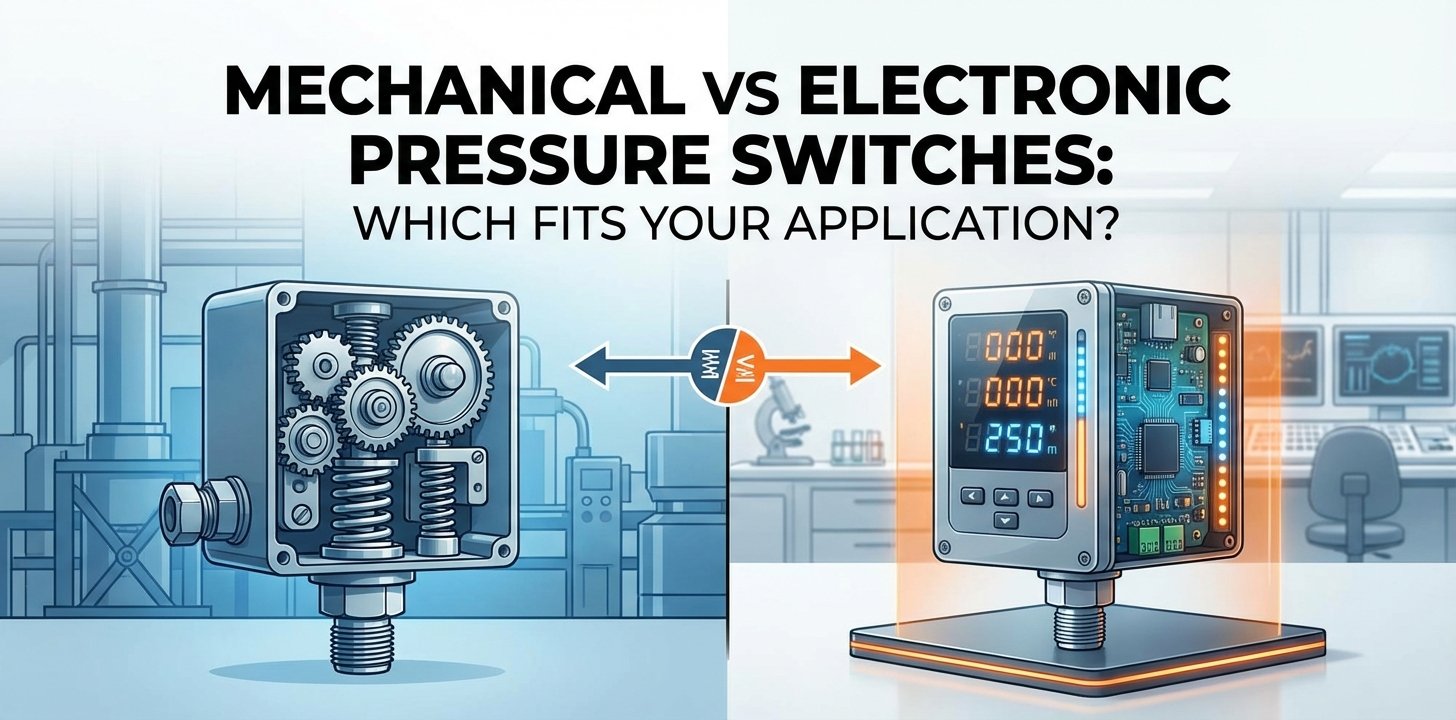
Mechanical vs Electronic Pressure Switches: Which Fits Your Application?
Selecting between a mechanical pressure switch and an electronic pressure switch sensor represents more than a simple procurement decision—it directly impacts system safety, operational reliability, and long-term maintenance costs. While mechanical switches have served industry reliably for decades, modern electronic alternatives offer capabilities that address increasingly complex monitoring requirements. Understanding the fundamental differences, application-specific advantages, and safety implications of each technology ensures optimal pressure measurement performance in demanding industrial environments.
Understanding Fundamental Operating Principles
The distinction between mechanical and electronic pressure switches begins with how each technology converts pressure into a switching action.
Mechanical Pressure Switch Operation
A mechanical pressure switch uses direct physical force from process media to actuate an electrical contact. Pressure acts upon a diaphragm, piston, or Bourdon tube element, which moves against a calibrated spring until reaching the setpoint threshold. This mechanical displacement directly opens or closes electrical contacts through snap-action mechanisms. The simplicity of this design—no external power required for the sensing element itself—explains why mechanical switches remain prevalent in applications prioritizing fail-safe operation and intrinsic reliability.
SUCO’s mechanical pressure switches exemplify this proven technology, incorporating precision-machined brass or stainless steel housings with gold-plated contacts for corrosion resistance. The switching differential (hysteresis) is mechanically determined by spring characteristics and contact geometry, typically ranging from 5-15% of the setpoint value.
Electronic Pressure Switch Sensor Technology
Electronic pressure switch sensors employ semiconductor-based transducers that convert pressure into electrical signals before digital processing determines switching outputs. Modern implementations utilize Silicon-on-Sapphire (SoS) technology, where piezoresistive elements are deposited on sapphire substrates. This construction delivers exceptional stability across temperature extremes while maintaining accuracy under shock and vibration conditions that challenge traditional sensing methods.
The electronic architecture enables programmable setpoints, adjustable hysteresis, analog output signals for continuous monitoring, and diagnostic capabilities impossible with purely mechanical designs. However, these advantages require electrical power and introduce electronic components that demand proper specification for hazardous area applications.
Performance Characteristics Comparison
Different types of pressure switches excel in distinct performance parameters critical to industrial pressure measurement applications.
Accuracy and Repeatability
Mechanical switches typically offer repeatability within ±2-5% of full scale, sufficient for most process control applications where precise switching thresholds aren’t critical. Electronic sensors achieve ±0.5% accuracy or better, with minimal drift over time. For applications requiring tight process control—such as hydraulic systems in aerospace or precision lubrication monitoring—electronic precision prevents premature shutdowns and optimizes operating windows.
Response Time and Switching Speed
Mechanical contacts provide instantaneous switching once the pressure threshold is reached, with response times under 10 milliseconds. Electronic switches introduce minimal processing delays but can match mechanical speed while offering programmable delay timers that prevent nuisance tripping from pressure transients. In high-cycling applications like compressor control or pump protection, this configurability reduces mechanical wear and extends system life.
Temperature Compensation and Environmental Stability
Temperature variations significantly affect mechanical switch accuracy, as spring constants and material dimensions change with thermal expansion. Quality mechanical designs incorporate temperature compensation through material selection and mechanical geometry, but typically remain limited to specific temperature ranges.
Silicon-on-Sapphire electronic sensors maintain calibration across temperature ranges from -40°C to +125°C without degradation. The sapphire substrate’s thermal stability and electronic compensation algorithms eliminate temperature-induced errors that plague alternative sensing technologies. For offshore oil platforms, desert pipeline installations, or Arctic mining operations, this temperature performance proves essential.
Application-Specific Selection Criteria
Oil & Gas Production and Processing
Upstream oil and gas facilities demand pressure monitoring that survives extreme conditions while meeting stringent safety certifications. Mechanical pressure switches excel in wellhead monitoring and separator control where power availability may be limited and fail-safe operation is paramount. Their inherent simplicity means fewer failure modes in environments where maintenance access is expensive and infrequent.
Electronic pressure switch sensors prove advantageous in gas compression stations and FPSO vessels where multiple pressure thresholds, remote monitoring capability, and integration with distributed control systems justify the added complexity. ATEX and IECEx certified electronic switches with SoS sensors provide the reliability demanded by Zone 1 and Division 1 hazardous area classifications while delivering continuous analog signals for predictive maintenance programs.
Mobile Hydraulics and Construction Equipment
Construction machinery, mining vehicles, and agricultural equipment subject pressure switches to continuous vibration, mechanical shock, and contamination. Mechanical switches with robust spring assemblies and sealed housings withstand these conditions reliably, particularly in applications like hydraulic overload protection where simple on/off switching suffices.
Electronic sensors with shock-resistant SoS technology and IP67/IP69K ingress protection ratings enable condition monitoring and telemetry systems increasingly deployed in fleet management. The ability to transmit continuous pressure data allows predictive maintenance scheduling that reduces unplanned downtime—a significant cost factor in large equipment fleets.
Hydrogen Production and Fuel Cell Systems
The emerging hydrogen economy introduces unique pressure monitoring challenges. Hydrogen’s small molecular size causes permeation through elastomers and certain metals, while its wide flammability range demands rigorous safety systems. Electronic pressure switches with metal-sealed process connections and hermetic enclosures prevent hydrogen leakage while providing the accuracy needed for efficient electrolyzer operation and fuel cell stack management.
Multi-stage compression in hydrogen refueling stations benefits from electronic switches offering multiple independently configurable setpoints within a single device, reducing installation complexity and potential leak paths compared to multiple mechanical switches.
Aerospace and Defense Applications
Aircraft hydraulic systems, landing gear, and environmental control systems utilize pressure switches as safety-critical components subject to DO-160 environmental qualification. Mechanical switches provide proven reliability in primary flight control systems where simplicity and fault tolerance outweigh advanced features.
Electronic sensors enable health monitoring and prognostic maintenance in commercial aircraft, where continuous data collection supports condition-based maintenance programs that optimize aircraft availability. Military applications increasingly specify electronic switches with built-in diagnostics that support mission-critical system health management.
Safety Compliance and Hazardous Area Considerations
Selecting pressure switch electrical components for hazardous locations requires understanding intrinsic safety principles and applicable certification standards.
ATEX and IECEx Certification Requirements
Mechanical pressure switches achieve intrinsic safety more readily than electronic alternatives because the sensing element requires no power. Simple intrinsically safe (IS) barriers limit energy available to the switching contacts, preventing ignition of surrounding atmospheres. This straightforward approach suits Zone 0/Division 1 applications where continuous explosive atmospheres may exist.
Electronic pressure switch sensors require more complex safety analysis, as internal circuits need power for operation. However, properly certified electronic switches with energy-limiting circuits and encapsulation achieve equivalent safety ratings while providing enhanced functionality. SUCO’s ATEX-certified electronic switches employ multiple layers of protection: intrinsically safe circuit design, hermetic sealing, and robust enclosures rated for Zone 1/Division 1 installation.
SIL Ratings and Functional Safety
Safety Instrumented Systems (SIS) designed per IEC 61508 and IEC 61511 assign Safety Integrity Level (SIL) ratings based on failure probability. Mechanical switches, with their simple failure modes, readily achieve SIL 2 certification when properly specified. Electronic switches with self-diagnostic capabilities can meet SIL 3 requirements through automatic detection of sensor drift, circuit faults, and communication errors—providing quantifiable safety advantages in critical shutdown systems.
Total Cost of Ownership Analysis
Purchase price represents only a fraction of lifetime costs in industrial pressure measurement systems.
Installation and Commissioning
Mechanical switches require less installation infrastructure—no separate power supplies or signal conditioners in basic applications. However, applications requiring multiple setpoints need multiple switches, increasing material costs, installation labor, and potential leak points. Electronic switches with programmable multi-point switching reduce installation complexity while improving system flexibility.
Maintenance and Calibration Requirements
Mechanical contact wear necessitates periodic replacement, particularly in high-cycling applications. Contact oxidation and contamination can cause intermittent failures that prove difficult to diagnose. Electronic switches eliminate contact wear entirely, though they introduce potential electronic component failures. Quality electronic designs with comprehensive diagnostics detect degradation before failure, enabling predictive replacement during scheduled maintenance windows rather than emergency repairs.
Calibration intervals favor electronic sensors, as digital compensation and stable SoS sensing elements maintain accuracy over extended periods. Mechanical switches typically require annual verification and adjustment, whereas certified electronic switches may extend calibration intervals to 24-36 months under appropriate conditions.
Making the Right Selection
Choose mechanical pressure switches when applications prioritize:
- Maximum simplicity and fail-safe operation without external power
- Lowest initial cost for basic on/off switching requirements
- Proven technology acceptance in conservative industries
- Intrinsically safe operation with minimal certification complexity
- Straightforward replacement of existing mechanical switch installations
Select electronic pressure switch sensors when applications benefit from:
- High accuracy and stability across wide temperature ranges
- Multiple programmable setpoints within a single device
- Continuous analog output for process monitoring and data logging
- Self-diagnostic capabilities supporting predictive maintenance
- Integration with digital control systems and Industry 4.0 initiatives
- Extended calibration intervals reducing lifecycle costs
Frequently Asked Questions
Can electronic pressure switches operate in the same hazardous areas as mechanical switches?
Yes, properly certified electronic pressure switches meet identical ATEX and IECEx requirements as mechanical alternatives. Quality electronic switches incorporate intrinsically safe circuit design and appropriate enclosures for Zone 0, Zone 1, and Zone 2 (Division 1 and Division 2) installations. Certification documentation must be verified for specific area classifications.
What happens to electronic pressure switches during power failure?
Electronic switches require power for operation, so output states during power loss must be considered during system design. Many electronic switches can be configured for fail-safe operation—driving contacts to a predetermined safe state upon power interruption. Critical safety applications should incorporate redundant power supplies or hybrid systems combining electronic monitoring with mechanical backup switches.
How do pressure switch types affect system response in dynamic pressure applications?
Both mechanical and electronic switches respond rapidly to pressure changes, but electronic switches offer programmable time delays and filtering that prevent false triggering from pressure spikes or transients. This configurability proves valuable in applications like reciprocating compressors or pulsating pump systems where pressure oscillations might cause nuisance tripping with fixed-hysteresis mechanical switches.
Leveraging German Engineering Expertise
SUCO’s 80+ years of pressure switch development in Germany has produced both mechanical and electronic solutions that set industry standards for reliability in extreme environments. The company’s Silicon-on-Sapphire sensor technology addresses limitations of traditional strain gauge and thick-film sensors, delivering accuracy and stability that enable electronic switches to perform in applications previously requiring multiple mechanical devices.
Whether your application demands the proven simplicity of mechanical switching or the advanced capabilities of electronic pressure monitoring, proper specification ensures safe, reliable operation throughout the system lifecycle. Understanding the fundamental differences between these technologies, their respective advantages, and application-specific requirements enables informed decisions that optimize both performance and total cost of ownership.
Contact SUCO’s application engineering team to discuss your specific pressure monitoring requirements. Our technical specialists provide detailed selection guidance, compliance documentation, and custom configuration services that ensure optimal pressure switch performance in your demanding application.