
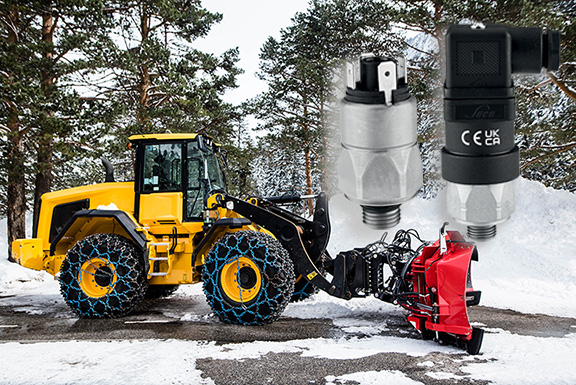
Snow vehicles, snow removal equipment, and ski lift hydraulic systems use pressure switches and pressure transducers for different purposes. Pressure switches activate or deactivate a circuit when pressure reaches a set point. Pressure transducers measure pressure continuously and send signals to a vehicle controller or display. Choosing the right device for your application and operating conditions is essential for reliable performance in winter environments.
Key takeaways
- Pressure switches: Open or close an electrical circuit when pressure reaches a specified set point. They do not provide a continuous pressure reading.
- Pressure transducers: Convert pressure measurements into continuous output signals, such as CANbus Pressure Transducer (CAN J1939 or 4–20 mA, allowing a controller to monitor actual system pressure.
- SUCO products for snow removal equipment: The snow removal equipment category includes pressure switch
Pressure Switch with Deutsch Connector – Series 0110,
High Pressure Switch with AMP Junior Timer Connector – Series 0119,
Diaphragm Pressure Switch with Zinc-plated Steel – 0166
Adjustable Hysteresis Low Voltage Pressure Switch – 0170,
CANbus Pressure Transducer and HP1000 pressure transducers. - Ski lift hydraulic systems: Hydraulic pressure monitoring for passenger ropeway systems requires specialized engineering review. Contact the SUCO ESI North America technical team before selecting a product for these applications
Two Devices, Two Jobs: Switches vs. Transducers in Winter Equipment
Engineers new to mobile hydraulics sometimes use “pressure sensor,” “pressure switch,” and “pressure transducer” interchangeably. In practice, confusing them during product selection leads to wiring mismatches, controller integration failures, and system downtime — problems no fleet manager wants in January. For a clear side-by-side explanation, see this guide on pressure sensors vs. pressure switches vs. pressure transducers.
| Characteristic | Pressure Switch | Pressure Transducer |
|---|---|---|
| Output type | On/off (switched contact or electronic switching output) | Continuous signal proportional to pressure |
| Typical output | NC or NO contact; PNP/NPN | 4–20 mA, 0–10 V, CAN J1939, RS-485 |
| Controller reads | Circuit open or closed | Actual pressure value |
| Typical snow equipment use | Hydraulic low-pressure warning, overload interlock, spreader engage | Real-time hydraulic pressure on a cab display, CAN vehicle network |
| Key selection term | Set point, hysteresis, NO/NC | Measuring range, output signal, accuracy |
On a plow truck, for example, a pressure switch might close a circuit to illuminate a dashboard warning lamp the moment hydraulic pressure drops below the set point — a pure on/off function. A pressure transducer on the same circuit would continuously report the actual hydraulic pressure to the truck’s ECU over CAN J1939, allowing the controller to make proportional decisions. Both are valid; the application dictates which you need, and many systems use both.
Pressure Switches for Snow Removal Equipment
SUCO ESI North America’s snow removal equipment category includes several mechanical pressure switch series, each built around a different connector standard. All of these are mechanical switches: they detect when pressure crosses the set point and switch an electrical circuit accordingly.
Connector Options Matched to OEM Wiring Harnesses
Snow removal OEMs and fleet rebuilders rarely have a single connector standard across their harnesses. The SUCO mechanical switch range addresses this directly:
- Deutsch DT04-2P connectors: Series 0110 (diaphragm) covers applications where the Deutsch ecosystem is already in place.
- AMP Superseal 1.5 connectors: Series 0112 (diaphragm) and Series 0113 (high pressure) are listed in the snow removal category and suit harnesses using Superseal sealing.
- Packard Metri-Pack 280 connectors: Series 0114 and Series 0115 cover this common OEM connector standard.
- Deutsch DT04-3P connectors: Series 0116 and Series 0117 for three-pin Deutsch configurations.
- AMP Junior Timer connectors: Series 0118 (diaphragm) and Series 0119 (high pressure) complete the connector options for truck and off-highway builders.
Matching the switch connector to the vehicle’s existing harness reduces installation time, eliminates adapter risk, and preserves the environmental sealing that harsh winter conditions demand. For guidance on how mechanical pressure switches operate at the component level, see how pressure switches work.
Pro tip
When specifying a snow plow hydraulic pressure switch, check the pressure range, overpressure rating and media on the series page at sucoesi.com. Piston pressure switches are not suitable for gaseous media, particularly oxygen. Confirm those details before finalizing the spec.
Low-Voltage and Adjustable-Hysteresis Variants
Series 0166 (diaphragm, zinc-plated steel) and Series 0170 (adjustable hysteresis, low voltage) round out the snow removal switch lineup. Series 0170 is a low-voltage switch from SUCO’s adjustable-hysteresis range; on these series the hysteresis (the gap between switching point and reset point) is factory-set.
Avoiding common specification errors matters here. Selecting a switch with the wrong pressure range or hysteresis for a snowplow hydraulic circuit can cause nuisance trips or, worse, missed alarms. The article on 7 critical mistakes when selecting industrial pressure switches covers these failure modes in practical detail.
Speak with Our Technical Team
Tell us your connector type, pressure range, and operating environment — the SUCO ESI North America technical team will recommend the right switch or transducer for your snow removal or winter equipment application.
Pressure Transducers for Snow Vehicles and Winter Equipment
Where a snow vehicle’s controller needs to read actual hydraulic or system pressure — not just a trip signal — a pressure transducer is the correct device. SUCO ESI North America lists two transducer families in the snow removal equipment category.
CANbus Pressure Transducer — Series 0630 & 0631
The CANbus Pressure Transducer Series 0630 & 0631 is built for mobile equipment that uses a CAN J1939 vehicle network. The transducer converts hydraulic pressure into a continuous digital message on the CAN bus, allowing the vehicle ECU to display pressure, log data, and control system behavior based on real pressure values. This is fundamentally different from a switch: the controller receives a number, not an open/closed signal.
Refer to sucoesi.com for the published temperature limits and measuring range options for this series.
HP1000 High-Pressure Transducer
The HP1000 High-Pressure Transducer is listed in the snow removal equipment category and is rated to pressures up to 5,000 bar (72,500 psi). It outputs a continuous signal proportional to pressure, making it a transducer, not a switch.
In a mobile hydraulic system, a pressure switch tells you something has gone wrong. A pressure transducer tells you exactly how wrong — and by how much.
Pressure Monitoring on Ski Lift Hydraulic Systems
Ski lift systems — including hydraulic tensioning systems and hydraulic braking systems — present genuine pressure monitoring requirements. Hydraulic pressure must remain within defined limits to maintain rope tension and ensure braking function. Whether that monitoring is best achieved with a pressure switch (set-point trip), a pressure transducer (continuous monitoring), or both depends on the specific lift design, the control architecture, and the applicable safety standards in the jurisdiction of installation.
Important notice for lift operators and builders
SUCO ESI North America does not publish any ski lift-specific approval, certification, or standard compliance for its pressure switches or transducers. No product on sucoesi.com is described as approved or certified for passenger ropeway systems. Lift builders and operators should contact the SUCO ESI North America technical team directly to discuss requirements before specifying any product for a passenger lift application.
In general engineering terms, hydraulic pressure switches can serve as hardwired safety interlocks — closing or opening a circuit when pressure falls outside a defined range — while pressure transducers provide continuous data to a PLC or safety controller for trend monitoring and predictive maintenance. The distinction between these two functions is critical in any safety-related application. For a deeper look at how mobile hydraulic pressure control systems are structured, see this guide on mobile hydraulics in automotive and transportation.
Frequently Asked Questions
What is the purpose of a pressure switch?
A pressure switch opens or closes an electrical circuit when the system pressure reaches a defined set point. It does not report a pressure value — its output is purely on or off. In snow removal equipment, a pressure switch might trigger a warning lamp, disable a hydraulic function, or engage an interlock when pressure crosses the switching point.
What happens when a pressure switch goes bad?
A failed pressure switch can cause the circuit it controls to remain permanently open or permanently closed, regardless of actual system pressure. This can mean a warning that never activates (dangerous) or an interlock that never releases (operationally disabling). Symptoms include alarms that trigger at the wrong time, hydraulic functions that won’t engage, or a warning lamp that stays on even when pressure is normal. Regular inspection of contacts, connectors, and seals is good maintenance practice.
What are two types of pressure switches?
The two main types are mechanical pressure switches and electronic pressure switches. Mechanical switches use a diaphragm or piston element to actuate a physical electrical contact when the set point is reached. Electronic pressure switches use a sensing element and electronic circuit to switch a PNP or NPN output. SUCO ESI North America supplies both types; the snow removal equipment category lists mechanical switch series. For a comparison of mechanical vs. electronic types, see the dedicated guide on mechanical vs. electronic pressure switches.
How do you adjust a pressure switch set point?
It depends on the series — check its product page on sucoesi.com. The simplest route is to order the switch preset: SUCO ESI North America’s St. Louis service center operates a certified test bench and dead-weight tester, and if a switch is in stock it can be set to your required set point and shipped the same day the order is placed, with next-day delivery across North America.
Speak with Our Technical Team
Tell us your connector type, pressure range, and operating environment — the SUCO ESI North America technical team will recommend the right switch or transducer for your snow removal or winter equipment application.

About SUCO ESI North America
SUCO ESI North America, part of the SUCO Group, supplies mechanical and electronic pressure switches designed and manufactured in Bietigheim-Bissingen, Germany, and ESI pressure transducers manufactured in Wrexham, UK, to industry across the U.S., Canada, Mexico and Latin America — including mobile hydraulics, construction, HVAC and refrigeration, industrial automation, oil & gas, aerospace and defense. From its St. Louis center it provides product selection support, same-day setpoint calibration and shipping for in-stock switches, and next-day delivery across North America. Visit sucoesi.com →