
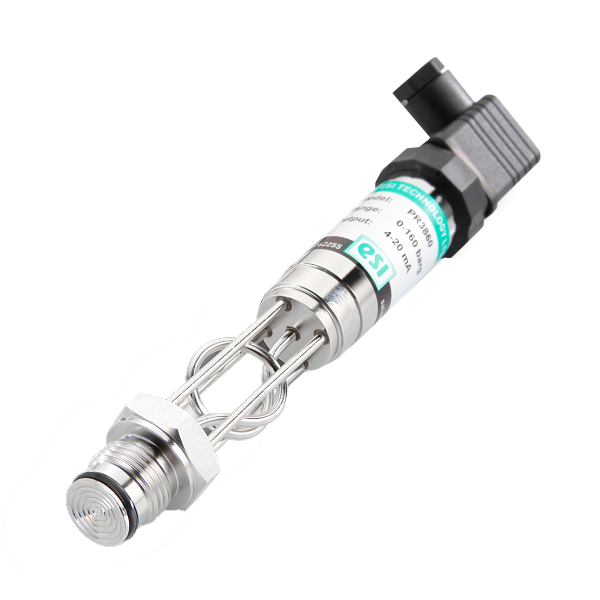
Despite the rapid expansion of digital fieldbus protocols and wireless sensing technologies, the 4-20mA current loop remains the backbone of industrial pressure measurement worldwide. In process plants, mobile machinery, and heavy-duty automation systems, engineers continue to specify analog pressure transducers for one fundamental reason: reliability under real-world conditions.
When a signal must travel hundreds of meters through electrically noisy industrial environments without degrading, when a PLC input card needs a universally compatible sensor, or when a system failure must be instantly detectable, the 4-20mA standard delivers in ways that newer technologies sometimes cannot match. This guide explores why; and helps you apply that knowledge to your next instrumentation project.
What Is a 4-20mA Pressure Transducer?
A 4-20mA pressure transducer converts a mechanical pressure input into a proportional electrical current signal. At zero pressure (or the minimum range point), the output is 4mA. At full-scale pressure, the output reaches 20mA. Any pressure value in between produces a precisely proportional current.
This is a current loop signal—not a voltage signal. That distinction matters enormously in industrial environments. Current, unlike voltage, does not degrade over long cable runs. A 4mA signal leaving a sensor in a remote wellhead arrives at the control room as exactly 4mA, regardless of cable resistance. Voltage signals don’t behave that way.
The 4mA live zero is equally important. It means a functioning sensor with zero applied pressure still transmits a signal. If the reading drops to 0mA, you immediately know there’s a wiring fault, power failure, or sensor damage—not a legitimate process reading. This built-in fault detection capability has made 4-20mA pressure transmitters a safety-critical standard across industries for decades.
Why Analog Still Outperforms Digital in Many Applications
Digital protocols like HART, PROFIBUS, and IO-Link offer advantages in configuration flexibility and diagnostics. But for straightforward, high-reliability pressure monitoring, analog current loops consistently demonstrate practical advantages.
Noise Immunity Over Long Distances
Industrial plants generate significant electromagnetic interference from motors, drives, welding equipment, and high-voltage cabling. Voltage-based signals are susceptible to this noise. Current loop signals are inherently immune—any noise-induced voltage fluctuation on the cable does not affect the current flowing through it. This is why analog pressure transducers remain preferred in environments like offshore platforms, mining operations, and construction machinery where cable routing near power systems is unavoidable.
Universal Compatibility
Every major PLC, DCS, and SCADA system manufactured in the last 30 years accepts 4-20mA inputs as a standard input type. There are no protocol mismatches, no gateway converters, and no firmware compatibility concerns. For OEM machine builders and plant engineers specifying replacement sensors, this universality eliminates integration risk entirely.
Simplified Wiring and Commissioning
A two-wire current loop transducer requires only two conductors for both power and signal. This reduces cable costs, simplifies terminal wiring, and lowers the risk of wiring errors during installation or maintenance. In mobile hydraulic systems where space and weight are constrained, two-wire industrial pressure transducers offer a meaningful practical advantage over more complex configurations.

Applications for 4-20mA Pressure Transducers
Oil and Gas Process Control
Upstream and downstream oil and gas operations rely on continuous, accurate pressure data across wellheads, separators, pipelines, and compressor stations. Signal integrity over long cable runs is non-negotiable. In these environments, ATEX-certified analog pressure transducers are required by regulation for use in potentially explosive atmospheres. The 4-20mA standard aligns naturally with the intrinsically safe circuit designs specified under ATEX and IECEx frameworks, where limiting electrical energy in the hazardous zone is a fundamental safety requirement.
Industrial Automation and Process Manufacturing
In chemical processing, food and beverage production, and pharmaceutical manufacturing, pressure monitoring feeds directly into feedback control loops. A PID controller adjusting a pump or valve needs a continuous, real-time pressure signal—not a digital packet that arrives on a polling cycle. Analog pressure transducers provide that continuous signal naturally, making them the preferred input for closed-loop control applications where response time and signal continuity matter.
Mobile Hydraulics and Construction Equipment
Excavators, cranes, and heavy construction machinery operate in environments with significant vibration, shock loading, and temperature cycling. The simplicity of the 4-20mA circuit means fewer points of potential failure compared to digital sensor networks. For OEM designers building hydraulic control systems into heavy equipment, specifying proven analog pressure transducers reduces integration complexity while maintaining measurement accuracy under demanding mechanical conditions.
Water and Wastewater Treatment
Municipal and industrial water treatment plants often span large geographic footprints where sensors may be located significant distances from central control systems. Long cable runs in these environments are standard. The noise immunity and distance capability of current loop pressure transmitters make them the dominant sensor type in water infrastructure applications globally, as reflected in U.S. EPA guidance on water system instrumentation and control.
Selecting the Right 4-20mA Pressure Transducer
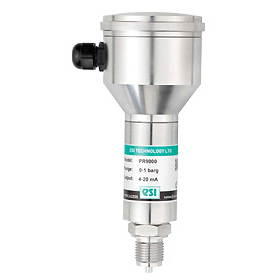
Not all analog pressure transducers are engineered equally. Several technical parameters determine whether a sensor will perform reliably over its service life in a demanding application.
- Pressure range and overpressure rating: Select a transducer with a full-scale range appropriate to your normal operating pressure, but confirm the overpressure rating exceeds anticipated surge or spike conditions—typically 1.5x to 3x the nominal range.
- Process media compatibility: Wetted materials (316L stainless steel, Hastelloy, titanium) must be chemically compatible with the measured fluid. This is particularly important in chemical processing and offshore applications.
- Accuracy and long-term stability: Specify combined error (including non-linearity, hysteresis, and repeatability) rather than linearity alone. Long-term stability over a calibration interval matters equally for process control quality.
- Temperature compensation range: Industrial environments rarely operate at stable ambient temperatures. Confirm the transducer maintains specified accuracy across the expected temperature range, including compensated and operating limits.
- Electrical protection: Look for reverse polarity protection, transient surge protection, and EMC compliance. These are not optional features in real industrial installations—they protect against field wiring errors and plant-generated transients.
- Hazardous area certification: For ATEX Zone 1 or Zone 2 applications, confirm the transducer carries valid ATEX and IECEx certification for the specific equipment group and category required by your installation. Certification markings must match the hazardous zone classification.
Contact SUCO ESI North America for technical support and application assistance.
Email: sales@sucoesi.com
Phone: 1-561-989-8499
Frequently Asked Questions
What does “live zero” mean in a 4-20mA pressure transducer?
Live zero refers to the 4mA minimum signal representing zero (or minimum range) pressure. Because a functioning sensor always transmits at least 4mA, a reading of 0mA unambiguously indicates a wiring fault, open circuit, or power failure—not a valid pressure reading. This built-in diagnostic capability is a core safety advantage of the 4-20mA standard.
How far can a 4-20mA current loop signal travel?
Current loop signals can travel reliably over cable runs of 300 meters or more, depending on cable resistance and supply voltage. The maximum distance is determined by the loop compliance voltage of the transmitter and the total cable resistance. Unlike voltage signals, the current value is not affected by resistive voltage drop along the cable, which is why long-distance transmission is a primary advantage of this signal standard.
Do 4-20mA pressure transducers require external power?
Two-wire (loop-powered) transducers draw their operating power directly from the current loop—no separate power supply is needed at the sensor. Four-wire transducers use a separate power supply and provide an independent 4-20mA output. Two-wire configurations are standard in most industrial installations due to their wiring simplicity and lower installation cost.
Can 4-20mA transducers work alongside digital communication protocols?
Yes. HART protocol transmitters superimpose a digital signal on the 4-20mA current loop, allowing both analog measurement and digital communication simultaneously over the same two wires. This approach is widely used in process industries where existing analog infrastructure is retained while adding digital diagnostic and configuration capability. The analog signal remains fully functional and unaffected by the digital communication.
Engineering Reliability Into Every Installation
The 4-20mA pressure transducer standard has endured for good reason: it works consistently in the environments where pressure measurement actually matters; noisy, remote, extreme, and safety-critical. Understanding the signal standard’s technical advantages helps engineers specify more confidently and troubleshoot more effectively.
At SUCO ESI North America, our analog pressure transducers are designed for exactly these demanding conditions. Whether you’re specifying sensors for an offshore installation, a hydraulic control system, or a process automation project, our engineering team can help match the right measurement solution to your specific requirements.
Written by Skyler Libkie, SUCO ESI North America writer