
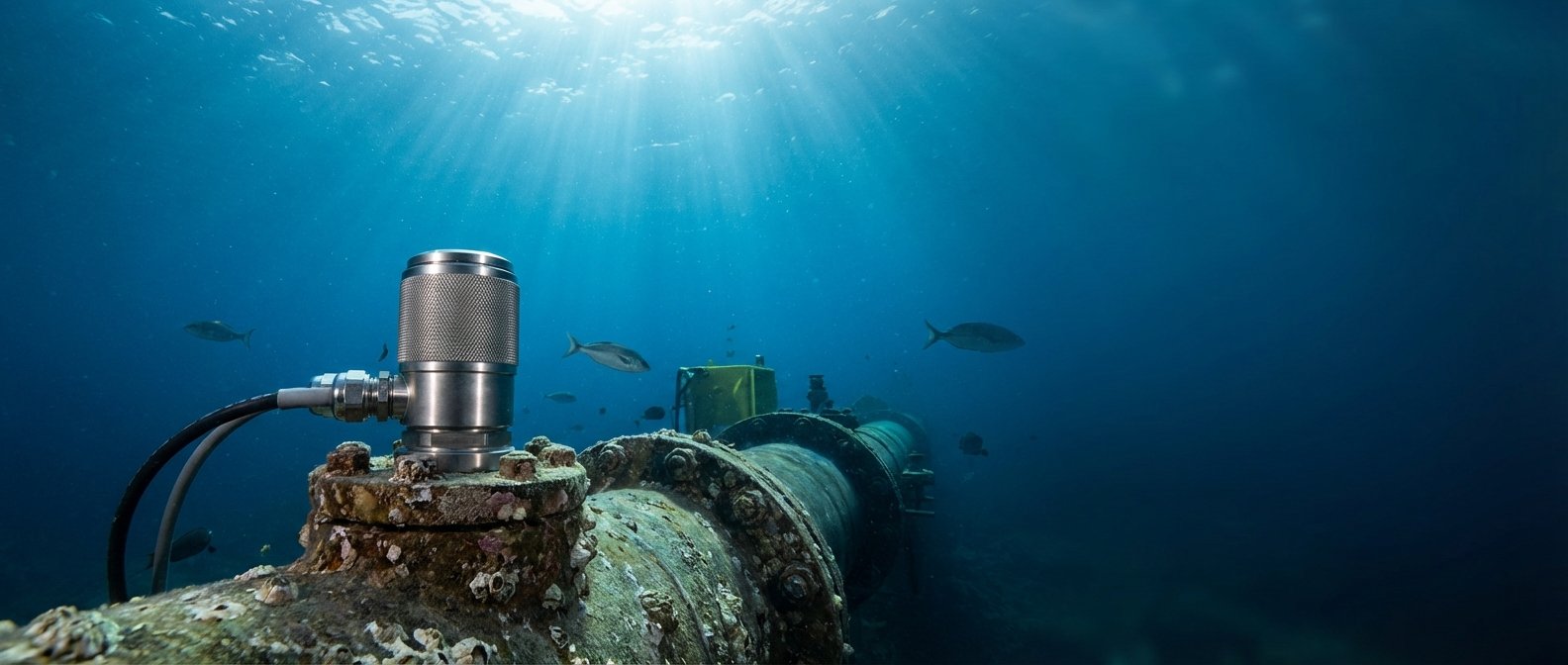
Offshore instrumentation doesn’t get a second chance. When a pressure sensor fails at 3,000 feet below the surface, there’s no quick swap-out — you’re looking at ROV mobilization, vessel costs, and potentially a production shutdown running $100,000 or more per day. Offshore pressure measurement is demanding in ways that most industrial applications simply aren’t.
What Makes Offshore So Different
Most industrial pressure sensors are designed for conditions that, while challenging, remain relatively accessible. Offshore environments are a different category entirely.
Seawater is chemically aggressive. It contains dissolved chlorides, sulfides, and biological organisms that attack 304 stainless steel and degrade polymer seals over time. Hydrostatic pressure from the water column alone adds approximately 0.445 PSI per foot of depth — so a sensor installed at 3,000 feet faces roughly 1,335 PSI of ambient pressure before process pressure is even factored in.
Then add temperature cycling. Equipment transitions from 80°F surface conditions to near-freezing deep-water temperatures during deployment, then heats back up near wellhead equipment. That thermal fatigue accumulates quickly in conventional sensor designs that rely on bonded strain gauges or fluid-filled sensing cavities.
The result is a failure mode that doesn’t show up in a lab spec sheet: sensors that perform well during factory acceptance testing but drift or fail within a year in service. It’s almost always tied to the same root causes — bonding agent degradation, moisture ingress at cable penetrations, or thermal mismatch in the sensing element assembly.
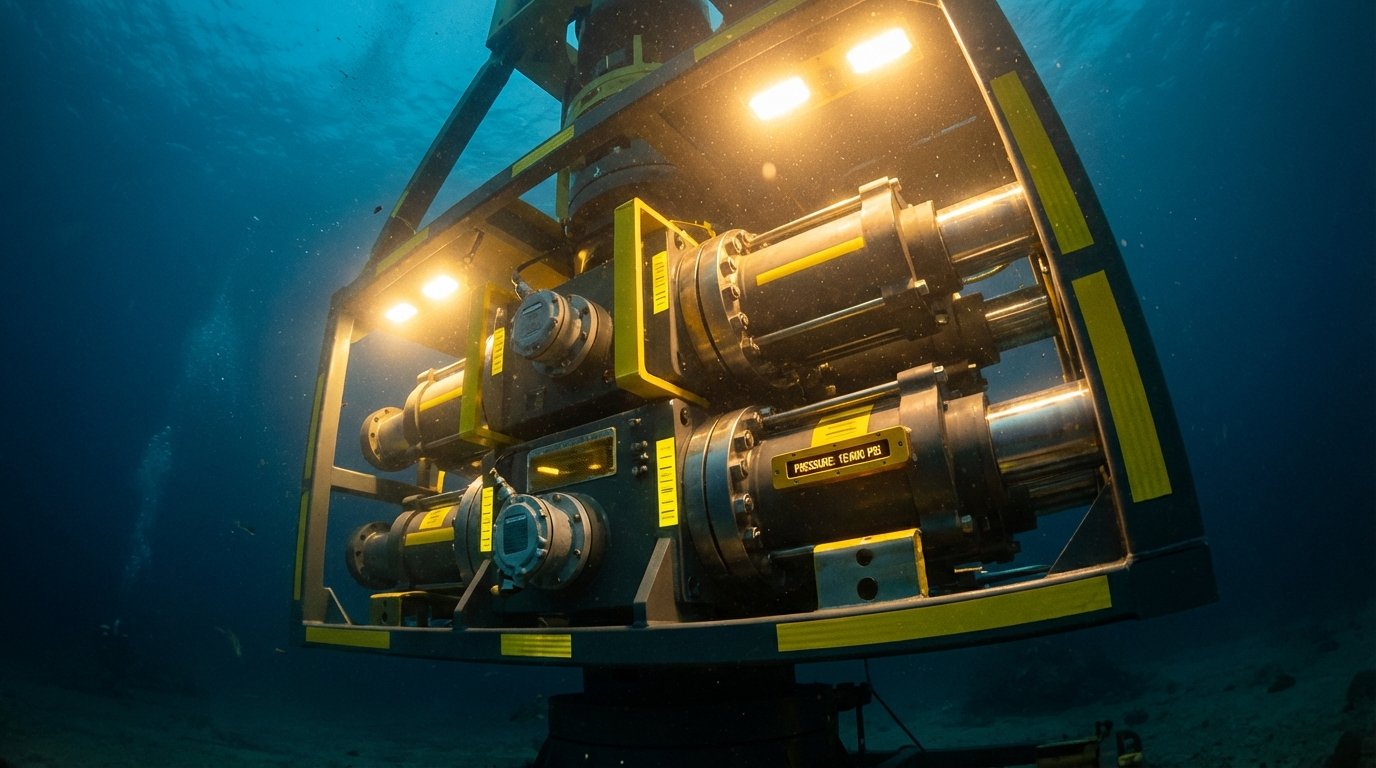
Where Pressure Monitoring Lives on an Offshore Platform
Before selecting a sensor, it helps to be clear-eyed about the application. Offshore pressure monitoring spans several distinct functions with very different requirements.
| Application | Pressure Range | Key Requirement |
|---|---|---|
| Blowout preventer (BOP) control hydraulics | 0–5,000 PSI | SIL-rated reliability, fast response |
| Wellhead / christmas tree monitoring | 0–15,000 PSI | Long-term stability, corrosion resistance |
| Pipeline leak detection | 0–3,000 PSI differential | High resolution, low drift |
| Subsea production manifolds | 0–10,000 PSI | Depth rating, ROV-compatible installation |
| Riser pressure monitoring | 0–5,000 PSI | Vibration tolerance, cable length |
Each row represents a different failure consequence. BOP hydraulics need sensors that will never give a false reading when it counts most. Pipeline monitoring needs resolution fine enough to detect slow leaks before they become incidents. Downhole wellhead applications need sensors that stay accurate for years without recalibration. Getting the specification right starts with knowing exactly which application you’re engineering for.
The Case for Silicon-on-Sapphire in Subsea Applications
Conventional piezoresistive sensors work well in typical industrial settings. The offshore environment, however, exploits their core weaknesses.
Most piezoresistive sensors bond a silicon sensing element to a steel diaphragm using adhesives or solder. Over time — especially through repeated thermal cycling — those bonding agents degrade. The result is zero drift that compounds year over year. In an accessible plant setting, you schedule a recalibration. On a subsea tree at 5,000 feet, you have a problem.
Silicon-on-Sapphire (SoS) technology takes a different approach. In the PR3914 and PR3915, a piezoresistive silicon strain gauge circuit is epitaxially grown onto the surface of a sapphire diaphragm to form a single crystalline structure, and the sapphire sensor element is then molecularly bonded to a titanium alloy sub-diaphragm. According to the datasheets, this enables the sensor to endure higher over-pressures, provides superb corrosion resistance, and gives virtually no hysteresis and excellent long-term stability over wide temperature ranges.
Construction Features That Actually Survive the Environment
Choosing the right sensing technology is step one. How the sensor is built around that element determines whether it survives in practice.
Wetted Materials
Material selection needs to account for the chemical environment — not just seawater, but produced fluids and any treatment chemicals present. Standard 316L stainless steel handles most applications. Sour service environments with elevated H₂S may require Hastelloy C276 or Inconel 718. Getting this wrong leads to stress corrosion cracking, which can progress from invisible to catastrophic failure in weeks.
Cable Penetrations
Cable entry points are a chronic weak point in subsea instrumentation. Water finds its way through any available path at depth. Marine-rated designs use compression gland seals with secondary potting compounds. The cable itself needs armored jacketing — typically stainless steel braid over polyurethane or neoprene — to survive deployment and retrieval operations.
Temperature Compensation
Digital sensors that measure temperature internally and apply mathematical corrections outperform passive compensation designs by a significant margin when operating across large temperature gradients. For sensors transitioning from near-surface to deep-water environments, this isn’t a nice-to-have — it’s a core accuracy requirement.
Electronics Sealing
Sealing should be hermetic, not just IP68 rated. IP ratings address ingress under static conditions; hermetic sealing addresses the pressure differential effects that degrade conventional O-ring seals in deep-water applications. Look for welded or glass-to-metal sealed electronics housings in critical applications.
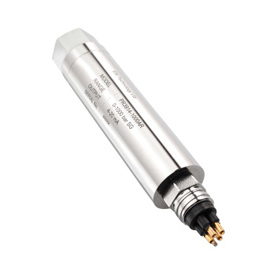 SUCO ESI North America’s PROTRAN PR3914 & PR3915:
Purpose-Built for Marine Service
The PROTRAN PR3914 and PR3915 series aren’t industrial sensors adapted for subsea duty — they’re designed for permanent immersion. The PR3914 withstands external pressures of up to 6,000 metres water depth, and the PR3915 is intended for permanent immersion in pressurised dielectric oil and withstands external pressure up to 3,000 metres water depth. Both pair the Silicon-on-Sapphire sensing element with a fully welded housing and NACE-conforming wetted parts.
| Specification | Detail |
|---|---|
| Pressure Range | Standard 0–16 bar (0–200 psi) to 0–600 bar (0–8,700 psi); ranges available to 2,000 bar (PR3914) and 1,000 bar (PR3915) |
| Accuracy | < ±0.25% of span BFSL (NLHR); typical thermal zero and span coefficients ±0.015%FS/°C (PR3914), ±0.005%FS/°C (PR3915) |
| Wetted Materials | SAE 316 stainless steel housing with titanium alloy measurement cell; wetted parts conform to the NACE recommendation for material corrosion resistance |
| Output Signal | 4–20mA, two-wire |
| Temperature Range | −20°C to +40°C (−4°F to +104°F) operating ambient and media temperature |
| Electronics Sealing | Fully welded housing; the PR3915 uses a high pressure glass-to-metal lead through |
| Certifications | UKCA and CE marked (PR3914); CE marked (PR3915) |
The 4–20mA current loop output is a deliberate engineering choice. Voltage-output sensors are practical in a control panel; at the end of a 500-foot subsea cable, they’re an invitation for noise problems. Current loops maintain signal integrity regardless of cable resistance — a basic decision that eliminates a common commissioning headache.
On the PR3914, electrical connection is via strong PTFE Raychem Flexlite leads. The PR3915 is available with a cable outlet or subsea connector options.
Installation and Maintenance Realities
Planning sensor installation offshore isn’t just about the sensor specification; it’s about the full lifecycle.
Direct-Mount vs. Remote Seal
Direct-mount sensors offer better response time and no fill fluid to manage, but they expose electronics to process conditions. Remote seal configurations isolate the sensor through a capillary-filled system; useful for very high temperatures or severely corrosive media, at the cost of slower response and potential fill fluid compatibility issues.
ROV Installation
Torque specs matter. ROV manipulators have defined torque output limits, and overtorqued connections damage both the sensor and the mating hardware. Any sensor specified for ROV installation should document installation torque requirements explicitly, with connections sized for standard manipulator tooling.
Calibration Planning
Safety-critical instrumentation in SIL-rated loops should follow the SIL maintenance plan regardless of sensor technology. Build your calibration schedule around application requirements, not just the sensor data sheet.
Redundancy
For any measurement feeding a safety system, dual-sensor redundancy isn’t optional. Cross-checking between two sensors monitoring the same point is standard practice and provides early warning of calibration drift before either sensor reaches its alarm setpoint.

Certifications: What the Offshore Industry Actually Requires
Requirements vary by jurisdiction and platform classification, but the following represent the baseline for most offshore projects:
| Certification / Standard | Scope | When Required |
|---|---|---|
| ATEX / IECEx | Explosive atmosphere protection | All equipment in classified zones (Zone 0/1/2) |
| DNV GL Type Approval | Maritime service — vibration, shock, EMI, seawater exposure | Subsea and offshore platform equipment |
| SIL Certification (IEC 61511) | Safety Instrumented System reliability (PFD) | Any sensor in a SIS loop |
| API 6A / ISO 13628 | Wellhead and subsea production systems | Wellhead and subsea tree instrumentation |
A note on documentation: Certification paperwork needs to follow the instrument by serial number. A type certificate alone isn’t sufficient — the specific unit installed needs traceability in the project documentation. This frequently catches projects off guard during offshore installation audits. > View SUCO certifications – PDF
Common Questions From the Field
What pressure range should I specify for a 5,000-foot installation?
Budget 0.445 PSI per foot for hydrostatic load — roughly 2,225 PSI at 5,000 feet. Add process pressure on top of that, then specify the sensor for 150–200% of maximum expected combined pressure. Deep-water applications should also account for pressure testing, which typically runs to 1.5× operating pressure.
Can I use a standard industrial sensor temporarily while awaiting a marine-rated unit?
Don’t. Industrial sensors lack pressure compensation for ambient water effects, the sealing for sustained immersion, and the material selection for marine corrosion. Short-term deployments with non-rated equipment have a failure rate that makes them false economy in almost every case.
How does saltwater affect calibration over time?
Properly sealed marine sensors with inert wetted materials maintain calibration well. The PR3914 and PR3915 datasheets describe their Silicon-on-Sapphire sensor as having virtually no hysteresis and excellent long-term stability over wide temperature ranges. The greater risk is biological fouling of pressure ports on flush-diaphragm designs. Scheduled cleaning during intervention campaigns protects accuracy in long-term installations.
What’s the actual cost difference between a marine-rated sensor and an industrial one?
Typically 3–5× for the sensor itself. Against the cost of a single ROV retrieval campaign — vessel day rates plus ROV time plus production loss; the premium pays for itself if it extends replacement intervals by even one year. The math is straightforward once you put real numbers to it.
The Practical Bottom Line
Offshore instrumentation failures are expensive in every direction — operationally, environmentally, and in terms of regulatory exposure. The sensor that saves $400 on the original purchase order rarely saves money when measured against the full project lifecycle.
The combination of Silicon-on-Sapphire stability, proper marine construction, and the right certifications isn’t premium specification for its own sake. It’s the engineering response to what these environments actually do to instrumentation over time.
SUCO ESI North America draws on more than 80 years of SUCO experience as a specialist manufacturer in fluid technology. Whether you’re working through a new development specification or a like-for-like replacement on aging subsea infrastructure, our applications engineering team can help you get it right.
Contact SUCO ESI North America for technical support and application assistance. We serve the US, Canada, and Latin America. Hablamos español.
Email: sales@sucoesi.com
Phone: 1-561-989-8499
Written by Skyler Libkie, SUCO ESI North America writer