

Updated September 23, 2026. An earlier version of this article described SUCO ESI North America pressure transducers as radiation-resistant and suitable for reactor and containment pressure measurement. Those statements were not supported by test data and have been removed. SUCO ESI North America has not tested any of its products for ionizing-radiation tolerance, and every product statement below is limited to the specifications published on our product pages and datasheets.
Nuclear power plants are among the hardest places to measure pressure. Ionizing radiation, high temperatures, strict containment rules and formal qualification programs rule out most standard industrial instruments. This guide explains what those demands are, states plainly where SUCO ESI North America’s published product specifications do and do not apply, and describes how to get a straight answer from our engineering team before you specify anything.
The short version: SUCO ESI North America publishes no radiation rating for any pressure transducer, has not measured radiation tolerance on any product, and does not present any product as nuclear-qualified. Our transducers should not be specified for locations exposed to ionizing radiation. They remain candidates for conventional, non-radiation service where their published specifications cover the conditions and the plant’s own engineering review accepts them.
What nuclear applications demand from a pressure transducer
Radiation tolerance
Neutron and gamma radiation degrade semiconductors, insulation, seals, cable jackets and potting compounds over time. Instruments installed inside radiation fields are therefore selected on a documented total ionizing dose (TID) rating established by irradiation testing, not on general ruggedness. If a manufacturer has not tested a product for radiation exposure, no radiation tolerance can be assumed.
High temperature
Primary coolant loops in pressurized-water reactors operate at roughly 300 °C (570 °F). Steam generators and secondary systems run at temperatures similar to those in conventional power plants but add thermal cycling during load changes, start-ups and outages. Where a transducer cannot tolerate the process temperature, plants use impulse lines or diaphragm seal systems to move the instrument to a cooler location, at the cost of added measurement error that has to be characterized.
Hermetic integrity
Instruments that form part of the containment boundary must not create a leak path. That typically means welded construction, hermetic electrical feedthroughs and no elastomer seals that can age or outgas. Whether a given construction is acceptable is decided by the plant’s qualification program, not by a catalog description.
Qualification and traceability
Equipment important to safety is qualified through formal programs, for example IEEE 323 for environmental qualification and IEEE 344 for seismic qualification, plus plant-specific requirements. These programs combine accelerated aging, radiation exposure, seismic testing and accident-condition simulation, and they require material certifications, process records and individual test data from the manufacturer. They are separate from, and far more demanding than, ordinary industrial certifications such as ATEX or IECEx.
Where SUCO ESI North America stands on each requirement
Radiation: no published rating and no test data
SUCO ESI North America has never measured the total ionizing dose tolerance of any of its pressure transducers, and none of our product pages or datasheets lists a radiation specification. Our engineering team’s guidance is direct: our transducers should not be assumed to be radiation-tolerant and should not be specified for locations exposed to ionizing radiation.
There is also an output-signal issue. Instruments used inside radiation environments are typically specified with unamplified millivolt-per-volt (mV/V) bridge outputs, because the signal-conditioning electronics inside an amplified transducer are the components most vulnerable to radiation. Most SUCO ESI North America transducers are amplified-output devices, with outputs such as 0.5–4.5 V ratiometric, 0–10 V, 4–20 mA, 5–21 mA or RS-485. Unamplified mV/V or mV versions also exist, such as the HI5000, the HI2200, the HI2000/HI2010 and the GS4201, but like every other product we sell they have never been radiation tested and are not offered for radiation environments. Even a 4–20 mA transducer would not normally be selected for a radiation environment.
One clarification, because it causes confusion: the Silicon-on-Sapphire sensing element used in many of our transducers has excellent electrical insulation properties, and our transducers meet the electromagnetic compatibility standards listed on their datasheets. Immunity to electromagnetic interference is an electrical-noise property. It says nothing about tolerance to neutron or gamma radiation.
Temperature: published limits are well below reactor conditions
Our highest published temperature ratings are 200 °C (392 °F), for the HI5000 downhole pressure transducer and the HI2200/HI2300 high-temperature pressure transducers. The HI6000 high-temperature pressure transmitter is rated for continuous operation up to 135 °C (275 °F) and short periods up to 150 °C (302 °F). The High-Performance series (0705, 0710 and 0720) is rated for media temperatures from −40 °C to +125 °C, with a compensated range of −40 °C to +80 °C. None of these ratings reach the roughly 300 °C of a reactor primary loop. Where a seal system or impulse line brings the sensed temperature inside a published range, the instrument’s suitability for that location is still a decision for the plant’s engineering review.
Construction: a subsea rating is not a containment qualification
Some of our subsea products are built for permanent underwater deployment. The PR3930 subsea pressure transducer, for example, is described on its product page as fully welded and hermetically sealed, hyperbaric tested and rated for submersion to 6,000 meters. That is a subsea rating. It has not been evaluated against nuclear containment requirements, and we do not present it as a containment-grade instrument.
Qualification: not published
SUCO ESI North America does not publish IEEE 323 or IEEE 344 qualification documentation for any product and does not present any product as nuclear-qualified or safety-related instrumentation. Our certifications are the ones shown on each product page, such as the ATEX and IECEx hazardous-area approvals carried by specific products.
Where our transducers do fit
Our published pressure transducer range is built for industrial and mobile hydraulics, process industry, high-temperature service to 200 °C, subsea and offshore work, hazardous areas (ATEX/IECEx), hydrogen, and aerospace and defense applications. On a nuclear site, that translates to conventional-area systems with no radiation exposure, where the pressure, temperature, media and electrical conditions fall inside a product’s published specifications and the plant’s engineering review accepts the instrument. Typical examples are balance-of-plant hydraulic and pneumatic equipment, cooling-water and building systems, and test and calibration benches.
Published specifications for the products most often asked about
The figures below are taken from the product pages and datasheets on sucoesi.com. If a value is not listed here, it is not a published specification, and we will not quote one from memory.
High-Performance series: 0705, 0710 and 0720
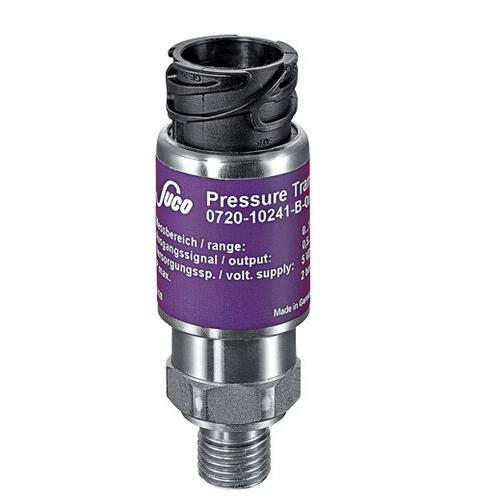
- Output signal: 0.5–4.5 V ratiometric (0705), 0–10 V three-wire (0710), 4–20 mA two-wire (0720)
- Standard pressure ranges: 0–10 bar to 0–600 bar (0–150 psi to 0–8,700 psi)
- Overpressure protection up to 1,650 bar (12,180 psi); burst pressure up to 2,000 bar, depending on range
- Accuracy ±0.5% full scale at room temperature (±0.25% BFSL); long-term stability ±0.1% FS per year; repeatability ±0.1% FS
- Temperature error ±0.01% FS per °C within the compensated range
- Temperature ranges: compensated −40 °C to +80 °C; ambient −40 °C to +100 °C; media −40 °C to +125 °C
- Wetted parts: stainless steel 1.4305 (SAE 303) and titanium, with no seals
- Response time (10–90%) of 2 ms or less; permitted pressure change rate up to 5,000 bar/s; mechanical life 10,000,000 pulsations
- Insulation resistance greater than 100 MΩ at 35 VDC; vibration resistance 20 g (4–2,000 Hz); shock 500 m/s² (11 ms)
- Protection class IP67 with M12, bayonet and cable connectors (IP65 with DIN EN 175301-803); EMC per 2014/30/EU, EN 61000-6-2 and EN 61000-6-3
- Not listed: any radiation rating
Download the 0705 / 0710 / 0720 datasheet (PDF)
HI6000 high-temperature pressure transmitter
- Continuous operation up to 135 °C (275 °F); short periods up to 150 °C (302 °F)
- Pressure ranges up to 1,500 bar (20,000 psi)
- Titanium wetted parts
- Silicon-on-Sapphire sensor; high-accuracy version available
- Outputs by model: 0–5 V, 0–10 V, 4–20 mA, 0.5–4.5 V ratiometric
- Not listed: any radiation rating
PR3930 subsea pressure transducer
- Submersion to 6,000 meters; hyperbaric tested (certification available up to 3,000 m); Environmental Stress Screening tested
- Pressure ranges up to 1,500 bar
- Outputs: RS-485 (communication distance up to 1,200 m) and 0–5 V analog
- Fully welded and hermetically sealed construction; Silicon-on-Sapphire sensor on a titanium alloy sub-diaphragm
- Not listed: any radiation rating
How to work with us on a nuclear-site project
Send our engineering team the actual conditions at the measurement point: pressure range, process and ambient temperature, media, required output and supply, ingress and hazardous-area requirements, and, above all, whether the location sees any ionizing radiation and what documentation the plant requires. We will tell you plainly whether a catalog product’s published specifications cover the application. If they do not, we will say so rather than stretch a claim to fit.
Email: sales@sucoesi.com
Phone: 1-561-989-8499
Frequently Asked Questions
Are SUCO ESI North America pressure transducers radiation resistant?
No radiation resistance is claimed. SUCO ESI North America has not measured the total ionizing dose tolerance of any product, no product page or datasheet lists a radiation rating, and our transducers should not be specified for locations exposed to ionizing radiation.
Which output signal is normally used for pressure sensors in radiation environments?
Instruments for ionizing-radiation environments are typically specified with unamplified millivolt-per-volt (mV/V) outputs, because the amplifier electronics inside a voltage-output or 4–20 mA transducer are the most radiation-sensitive parts. Most SUCO ESI North America transducers are amplified-output devices. Unamplified mV/V or mV versions, such as the HI5000, HI2200, HI2000/HI2010 and GS4201, also exist, but none of our products has been radiation tested and none is offered for radiation environments.
What is the highest temperature a SUCO ESI North America transducer is rated for?
Our highest published ratings are 200 °C (392 °F), for the HI5000 downhole pressure transducer and the HI2200/HI2300 high-temperature transducers. The HI6000 high-temperature pressure transmitter is rated for continuous operation up to 135 °C (275 °F) and short periods up to 150 °C (302 °F), and the High-Performance 0705, 0710 and 0720 series for media temperatures up to +125 °C. All of these are far below reactor primary-loop temperatures of roughly 300 °C.
What is Silicon-on-Sapphire (SOS) sensor technology?
A Silicon-on-Sapphire sensor uses silicon strain gauges grown directly onto a sapphire substrate, with no bonding agent between the sensing element and the substrate. The result is virtually no hysteresis, excellent long-term stability, a wide operating temperature range and strong corrosion resistance. The technology is used in many SUCO ESI North America transducers, but it does not carry a radiation rating. Read more about Silicon-on-Sapphire technology.
Published by SUCO ESI North America. Revised September 23, 2026 to remove unsupported radiation and nuclear-suitability claims; product statements now reflect published specifications only.