
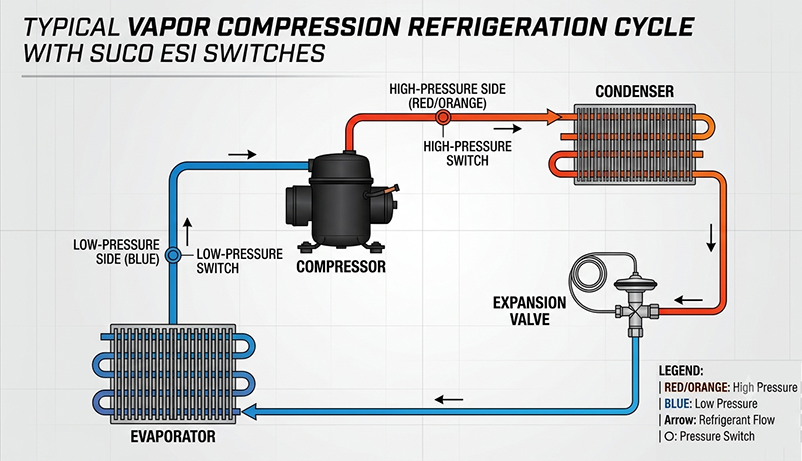
Selecting the right refrigeration pressure switch is one of the most important decisions you can make when designing or maintaining a refrigeration system. The wrong switch can lead to nuisance shutdowns, poor compressor performance, refrigerant leaks, or even costly equipment damage.
At SUCO ESI North America, we’ve worked with OEMs, engineers, and maintenance professionals across a wide range of refrigeration applications. While every system is different, the selection process always starts with understanding your operating conditions and choosing a pressure switch designed for those requirements.
If you’re looking for a general overview of pressure switch selection, we recommend starting with our How to Choose a Pressure Switch guide. This article focuses specifically on refrigeration systems and the factors that matter most.
Key Factors When Choosing a Refrigeration Pressure Switch
Before selecting a pressure switch, consider these key specifications:
- Set point and differential – The pressure at which the switch activates and the pressure at which it resets.
- Refrigerant compatibility – Ensure all wetted materials are compatible with the refrigerant used in your system.
- Operating pressure range – High-side and low-side pressures vary significantly depending on the refrigerant.
- Fixed or adjustable set point – Determine whether your application requires factory-set or field-adjustable settings.
- Electrical rating – Verify the contact configuration (SPDT, DPDT, NO/NC) along with the required voltage and current ratings.
- Process connection and mounting – Choose the correct port size, thread type, and mounting configuration.
- Operating environment – Consider ambient temperature, vibration, moisture, and the required IP protection rating.
Taking the time to review these requirements early helps prevent installation issues and improves long-term system reliability.
Set Point, Differential, and Pressure Range
 The set point, differential, and pressure range work together and should always be considered as a package.
The set point is the pressure at which the switch changes state. The differential is the amount of pressure required before the switch resets. Together, these values determine how your refrigeration system cycles during normal operation.
The refrigerant you’re using has a major impact on pressure switch selection. Refrigerants such as R-134a, R-404A, R-410A, R-448A, and CO₂ (R-744) all operate within different pressure ranges. For example, R-410A systems commonly operate above 400 psig on the high side, while transcritical CO₂ systems can exceed 1,500 psig. A pressure switch designed for one refrigerant may not be suitable for another.
For high-pressure compressor protection, the switch should trip before the system reaches its maximum allowable working pressure (MAWP), while still allowing for normal operating pressure fluctuations. A differential that’s too narrow can cause unnecessary cycling, while one that’s too wide may delay protection when it’s needed most.
Low-pressure switches serve a different purpose. They’re commonly used to detect refrigerant loss, protect against evaporator freeze-up, or control compressor cycling. These applications typically require a narrower differential for more responsive operation.
When in doubt, always follow the compressor manufacturer’s recommendations and verify the pressure limits for your specific refrigeration system.
Refrigerant Compatibility and Wetted Materials
Not all refrigerants interact with materials the same way, making material compatibility an important part of pressure switch selection.
Newer HFO refrigerants and refrigerant blends may affect certain elastomers differently than traditional HFC refrigerants. CO₂ systems introduce higher operating pressures and, when moisture is present, can form carbonic acid. Industrial ammonia (R-717) systems require even greater attention, as ammonia is incompatible with copper and many copper alloys.
Before selecting a pressure switch, verify the following materials:
- Diaphragm or bellows – Commonly stainless steel or fluoropolymer-lined materials for many refrigerants, with PTFE-compatible options available for ammonia applications.
- Pressure port and wetted metal components – Stainless steel is often preferred, especially for demanding or corrosive environments. Copper and brass should not be used in ammonia systems.
- Seals and O-rings – Confirm compatibility with the refrigerant being used, whether HNBR, EPDM, PTFE, or another approved material.
At SUCO ESI North America, we always recommend confirming material compatibility with both the refrigerant manufacturer’s Safety Data Sheet (SDS) and the pressure switch specifications before finalizing your design.
Fixed vs. Adjustable Pressure Switches
The next decision is whether your application requires a fixed or adjustable pressure switch.
Fixed-set pressure switches are factory calibrated and cannot be adjusted in the field. They’re an excellent choice for OEM equipment where operating conditions remain consistent. Because the settings cannot be changed, they provide excellent repeatability while reducing the risk of accidental adjustments during installation or service.
Adjustable pressure switches allow technicians to fine-tune the set point—and in some models, the differential—during commissioning or maintenance. They’re often used when operating conditions vary, multiple refrigerants are supported, or system optimization is required after installation.
Both options have advantages. The best choice depends on how much flexibility your application requires. If an adjustable switch is selected, we recommend documenting the final settings and, where appropriate, sealing the adjustment to prevent unintended changes after commissioning.
For more information see our Mechanical Pressure Switches
Matching the Switch to the Application
Compressor High-Pressure Protection
This is the most safety-critical pressure switch position in any refrigeration system. The high-pressure cutout must interrupt the compressor circuit before pressure reaches the system’s safety relief valve set point. In most jurisdictions, this is required by code (ASHRAE 15, EN 378, or equivalent).
Specify a switch with a manual reset function for high-pressure cutout applications. An automatic-reset switch on a high-pressure circuit masks the root cause—the system simply restarts, potentially cycling into the fault condition repeatedly.
Low-Pressure / Loss-of-Charge Detection
Low-side pressure switches protect against compressor operation under low refrigerant conditions, which causes inadequate cooling and can damage the compressor from poor lubrication and overheating. Automatic reset is generally acceptable here since nuisance trips (door left open, high ambient temperature) are common.
Head Pressure Control and Condenser Fan Staging
In systems with multiple condenser fans or variable-speed drives, pressure switches can stage fan operation based on head pressure. This application doesn’t require the same safety-critical reliability as compressor protection but does benefit from tight, repeatable differentials to prevent short-cycling of fan motors. Explore the full range of pressure switches for cooling and refrigeration systems to match this type of application.
Mechanical vs. Electronic Pressure Switches
Mechanical pressure switches use a diaphragm or bellows acting on a snap-action microswitch. They require no external power, are inherently fail-safe in most configurations, and have proven reliability in commercial refrigeration over decades. They’re the default for most OEM and commercial refrigeration applications.
Electronic pressure switches use a pressure sensor element and internal logic to trigger a solid-state or relay output. They offer advantages in applications that need digital displays, programmable set points, multiple output channels, or communication interfaces (IO-Link, 4–20 mA). For complex systems where set points change regularly or where the switch needs to report status upstream to a building management system, electronic switches earn their cost premium.
Electronic versions also provide tighter repeatability across temperature extremes and longer service life in high-cycle applications. For guidance on programming and configuring electronic versions, see Electronic Pressure Switch Programming for 2026.
If you’re unsure which approach fits your system, the comparison in Mechanical vs. Electronic Pressure Switches: Which Fits Your Application? provides a direct side-by-side breakdown.
How SUCO ESI North America Supports Refrigeration OEMs
SUCO ESI North America brings more than 80 years of pressure control engineering to refrigeration and HVAC/R (heating, ventilation, air conditioning, and refrigeration) applications. Our datasheets do not list compatibility with specific refrigerants, so confirm the refrigerant you use and the switch series you are considering with our engineering team before finalizing your design.
For OEM design engineers, the value is in customization. Standard catalog switches are the starting point, not the limit. Wetted materials, set points, electrical configurations, and mounting options can be specified to match the exact requirements of a refrigeration platform without the risk of compromising on fit or performance.
Frequently Asked Questions
Is a 30/50 or 40/60 pressure switch better?
Neither is universally better—the right set point range depends on your system’s working pressure requirements. A 30/50 switch (cuts in at 30 psi, cuts out at 50 psi) suits lower-pressure systems. A 40/60 switch fits systems requiring a higher operating band. Always match the range to the refrigerant’s normal operating pressures and the equipment manufacturer’s specifications.
How do I know which pressure switch to buy?
Start with four parameters: the required set point, the refrigerant type, the electrical load the switch must switch, and whether you need fixed or adjustable. From there, verify wetted material compatibility and confirm the ambient temperature range. If those parameters don’t match a standard catalog switch, talk to the manufacturer’s engineering team about custom options.
Can you adjust a 20–40 pressure switch to 40–60?
No. A 20–40 switch is designed and calibrated for that pressure range. The mechanical elements—spring rate, diaphragm sizing—are engineered for that envelope. Attempting to adjust it beyond its designed range compromises accuracy and reliability, and may exceed the pressure rating of internal components. Specify the correct range from the start.
How do you size a pressure switch for a refrigeration system?
Sizing involves matching the switch’s set point to the system’s high-side or low-side operating pressure, with the trip point set below the safety relief valve pressure (high side) or above the minimum safe suction pressure (low side). The differential should be wide enough to prevent short-cycling but narrow enough to catch fault conditions quickly. Always cross-reference with the compressor manufacturer’s recommended cut-in and cut-out pressures.
What IP rating do I need for a refrigeration pressure switch?
At minimum, IP54 for indoor commercial refrigeration in a machine room environment. IP65 or IP67 for outdoor condensing units, walk-in cooler connections exposed to wash-down conditions, or any installation where moisture intrusion is a credible risk. Cold-storage environments with frequent defrost cycles are particularly demanding—verify the IP rating is tested at the application’s temperature range, not just at room temperature.
Do refrigeration pressure switches need to be replaced on a schedule?
Most mechanical pressure switches are rated by cycle life, not calendar time. In high-cycle applications like condenser fan staging, a switch may reach end-of-life sooner than in a compressor protection role where it trips only during fault conditions. Review the manufacturer’s cycle life specification and implement condition-based replacement if cycle counting is feasible, or scheduled replacement based on system duty cycle in high-frequency applications.
Contact SUCO ESI North America to request a quote or speak with an applications engineer about your refrigeration pressure switch requirements.