
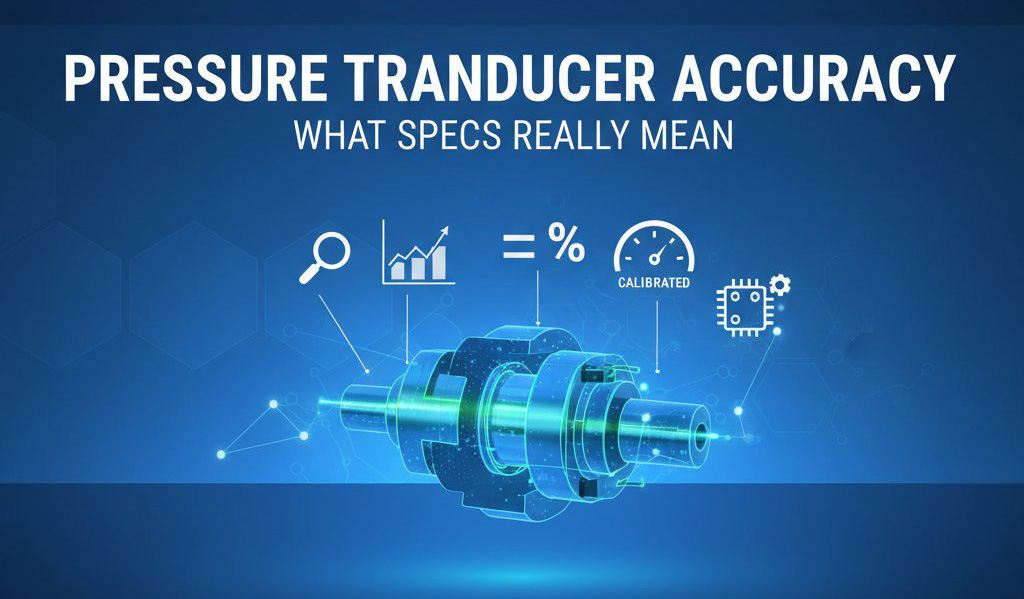
When a pressure monitoring system fails in a hydraulic excavator or HVAC chiller, the root cause is often misinterpreting accuracy specifications. Engineers frequently assume that a ±0.5% accuracy rating guarantees reliable measurements across all conditions but this is not the full picture. Misunderstanding the nuances of transducer specifications can lead to:
- System drift or calibration errors
- Unexpected shutdowns
- Catastrophic equipment failure
1. Accuracy Specifications: Beyond the Percentage
Accuracy numbers on a datasheet define operational boundaries, long-term performance, and safety, not just immediate measurement precision.
Key distinctions for engineers:
- % Full Scale (%FS) – Absolute error is constant across the range.
Example: ±0.5% FS on a 0–400 bar sensor → ±2 bar error, whether measuring 50 bar or 350 bar. - % of Reading (%RDG) – Error scales with measured value. More precise at low pressures, critical for variable flow or proportional control systems.
Takeaway: Always check if the accuracy is FS-based or reading-based to predict performance across your operating range.
2. Total Error Band (TEB): Real-World Accuracy
TEB includes:
- Non-linearity
- Hysteresis
- Non-repeatability
- Thermal effects
Why it matters:
A sensor may have ±0.5% basic accuracy but ±1.5% TEB in real-world conditions.
Construction equipment often faces -40°C (-40°F) to +85°C (+185°F). TEB accounts for these thermal effects.
Tip: Specify sensors using TEB for true field performance.
3. Resolution vs Accuracy
Engineers frequently conflate resolution with accuracy, leading to specification mismatches that compromise system performance. Resolution defines the smallest pressure change a transducer can detect and display, typically limited by analog-to-digital conversion or output signal characteristics. Analog pressure transducers with 4-20mA outputs operating on standard PLCs might resolve pressure changes to 0.1 bar, but this says nothing about measurement accuracy.
A transducer can offer exceptional resolution while delivering poor accuracy. Consider a 0-250 bar industrial pressure transducer with 16-bit resolution providing 0.004 bar resolution steps. If accuracy sits at ±2.5 bar (±1% FS), those fine resolution steps detect changes the transducer cannot accurately measure. This resolution-accuracy gap creates false confidence in precision control applications.
For mobile hydraulics controlling implement positioning or load sensing, matching resolution and accuracy prevents over-specification. Specifying excessive resolution adds cost without performance benefits when accuracy limitations dominate. Conversely, insufficient resolution in high-accuracy applications wastes sensor capability—like reading a precision instrument through fogged glass.
4. Temperature Effects
- Thermal coefficients: show error per °C outside compensated range.
Example: ±0.02% FS/°C shift → 20°C beyond range adds ±0.4% FS error. - Compensated vs. Operating Range:
Compensated: where accuracy is guaranteed
Operating: survival range; may degrade accuracy
Applications:
- Rooftop HVAC sensors face solar heating, wind chill, and temperature gradients. Compensated ranges of -40°C (-40°F) to +125°C (+257°F) are ideal.
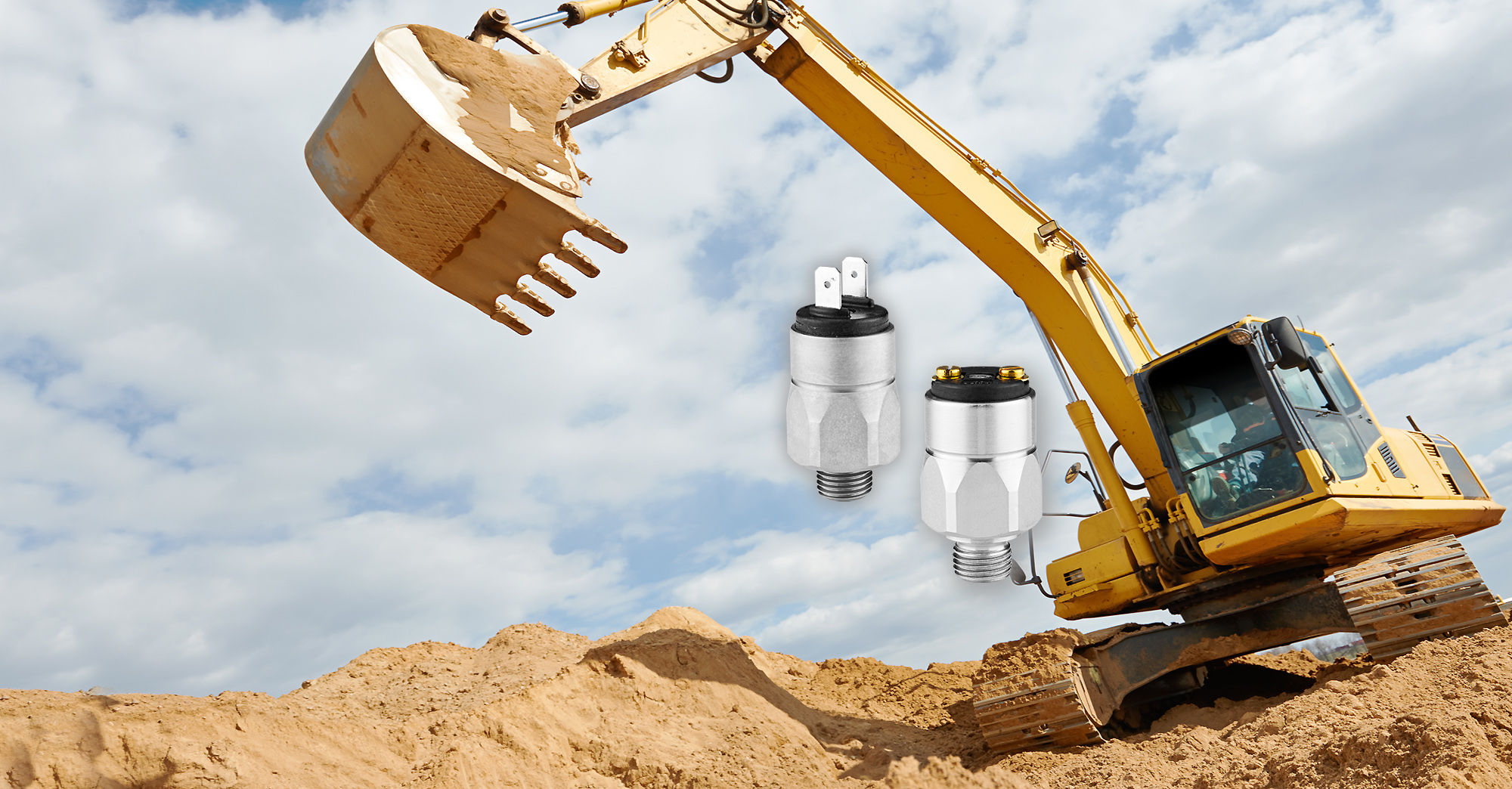
- Mobile hydraulics near engines/exhaust experience thermal cycling. Silicon-on-Sapphire sensors excel in thermal stability.
5. Stability & Long-Term Drift
Accuracy specifications describe performance at the moment of calibration. Stability specifications predict how that accuracy changes over time. Annual drift specifications, typically expressed as percentage of full scale per year, forecast calibration intervals and lifecycle performance. A transducer specified at ±0.1% FS/year drift allows predictive maintenance scheduling and confidence in measurement integrity between calibrations.
Different sensing technologies age at different rates. Strain gauge sensors using organic adhesives experience drift as bonding compounds cure and stress-relieve over time. Silicon-on-Sapphire technology eliminates adhesive layers entirely through direct semiconductor deposition, dramatically reducing aging mechanisms. In critical building management systems controlling pressure differentials for clean rooms or laboratory environments, this stability difference determines whether annual recalibration suffices or quarterly verification becomes necessary.
6. Dynamic Accuracy & Response Time
- Static accuracy: stable pressure only
- Dynamic accuracy: rapid pressure changes
- Response time: time to reach 90% of final value
- 1–2 ms sensors capture fast transients → critical for:
Compressor protection
Detecting pressure spikes
Load-sensing hydraulics
Frequency response: sensors must track oscillating pressures while ignoring irrelevant high-frequency noise.
7. Output Signal & Supply Voltage
Signal format:
- 4–20mA → noise-resistant, ideal for long cable runs
0.5–4.5V → higher resolution but sensitive to voltage fluctuations
Supply voltage effects:
- ±10% variation can degrade accuracy
- Wide-range sensors (8–32VDC) with internal regulation maintain accuracy under fluctuating electrical conditions
8. Practical Selection Guidelines
Start with application requirements:
- Hydraulic control: ±25mm implement positioning → define pressure error tolerance
- Building automation: detect 20% pressure rise across filters → ±2% FS may suffice
- Proportional valve control: ±0.5% FS for high-precision
Environmental margin factors:
- If sensor is rated ±0.5% TEB at +120°C (+248°F), derate to ±0.75% FS for safety
- Avoid operating at specification limits to prevent surprises
The SUCO Engineering Advantage in Accuracy Performance
Eight decades of German engineering experience in precision pressure measurement technology informs SUCO’s approach to accuracy specifications. This engineering philosophy stems from applications heritage in demanding sectors where measurement failure carries severe consequences; aerospace, defense, and heavy mobile equipment.
Silicon-on-Sapphire sensor technology delivers accuracy advantages through fundamental physics rather than calibration tricks. The monolithic sensing element eliminates mechanical interfaces that introduce hysteresis. Sapphire’s exceptional material stability resists drift mechanisms that plague alternative technologies. The sensor exhibits virtually no hysteresis and excellent long-term stability over wide temperature ranges.
For engineers specifying pressure measurement solutions in construction equipment, HVAC systems, or mobile hydraulics, SUCO’s combination of proven sensing technology and application expertise helps accuracy specifications translate to reliable field performance. The difference between datasheet promises and real-world results often determines project success or costly redesign.
Making Informed Accuracy Decisions
Understanding pressure transducer accuracy specifications transforms component selection from guesswork into engineering analysis. Total Error Band provides the most complete performance picture. Temperature coefficients predict real-world operation beyond controlled calibration labs. Long-term stability specifications forecast lifecycle performance and maintenance requirements. Dynamic characteristics address applications where pressure changes rapidly.
SUCO Engineering supports technical decision-makers with application-specific guidance on accuracy requirements, environmental considerations, and technology selection. Our team brings practical experience across industries to help match pressure transducer specifications to your exact requirements.
Get Expert Help Choosing the Right Sensor
Looking for the best reliable pressure sensors in North America or Latin America?
Contact SUCO to get expert help and the best solution for your hydraulic or HVAC application.
Email: sales@sucoesi.com
Phone: 1-561-989-8499
Reviewed by Gabriel Castrillo, VP of Sales