
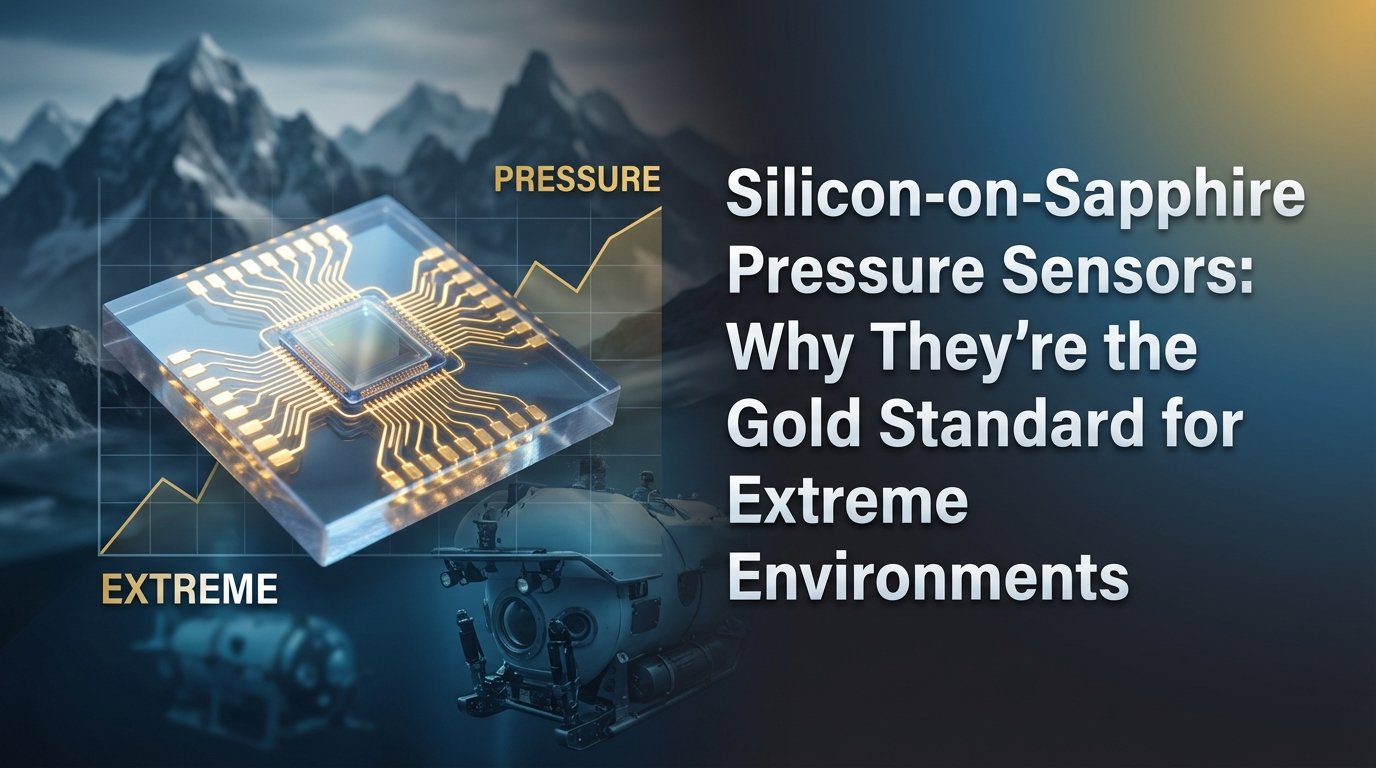
Silicon-on-Sapphire Pressure Sensors: Why They’re the Gold Standard for Extreme Environments
When pressure measurement failure isn’t an option—whether in subsea oil extraction at 15,000 PSI, hydrogen refueling stations, or aerospace applications experiencing -65°C temperatures—the sensor technology you choose becomes a critical safety and operational decision. Silicon-on-Sapphire sensors have emerged as the preferred solution for engineers facing the harshest industrial conditions, and understanding why requires examining both the fundamental physics and real-world performance data that separate this technology from conventional alternatives.
The Physics Behind Silicon-on-Sapphire Technology
Silicon-on-Sapphire (SOS) sensors represent a fundamental departure from traditional piezoresistive pressure sensor design. The technology bonds a thin silicon film directly onto a sapphire substrate, creating a pressure-sensing element that leverages the superior material properties of both components. The sapphire base provides exceptional mechanical strength and chemical inertness, while the silicon layer contains the piezoresistive elements that convert mechanical stress into electrical signals.
This architecture delivers measurable advantages in extreme conditions. Sapphire’s crystalline structure remains stable across temperature ranges from -65°C to +400°C, eliminating the thermal drift and hysteresis problems that plague conventional stainless steel diaphragm sensors. The chemical bond between silicon and sapphire creates a monolithic structure without adhesives or intermediate materials that could degrade under thermal cycling or aggressive media exposure.
For instrumentation engineers specifying sensors for critical applications, these material science advantages translate directly into performance metrics: thermal error budgets under 0.5% FSO across the full temperature range, long-term stability exceeding five years without recalibration, and immunity to hydrogen embrittlement that destroys conventional sensors in hydrogen applications.
Extreme Environment Performance: Where SOS Sensors Excel
High-Pressure Industrial Applications
High pressure transducers using Silicon-on-Sapphire technology routinely operate in pressure ranges exceeding 10,000 PSI where conventional sensors experience catastrophic failure or unacceptable drift. In hydraulic systems for construction equipment and mining machinery, SOS sensors maintain accuracy specifications even when subjected to pressure spikes that would damage traditional piezoresistive designs.
The sapphire diaphragm’s fracture toughness—approximately four times greater than stainless steel—provides an inherent safety margin. During pressure overshoot events common in hydraulic applications, this mechanical robustness prevents sensor rupture that could compromise system safety or create hazardous fluid releases.
Cryogenic and High-Temperature Extremes
Aerospace pressure monitoring systems demand sensors that function reliably across atmospheric temperature variations from ground operations to high-altitude flight. Silicon-on-Sapphire sensors maintain calibration accuracy in liquid oxygen systems at -183°C and turbine monitoring applications exceeding 300°C—temperature ranges that cause significant zero-shift and span errors in conventional designs.
The thermal coefficient of expansion matching between silicon and sapphire minimizes mechanical stress during temperature cycling, eliminating a primary failure mechanism. This material compatibility is why aerospace OEMs increasingly specify SOS technology for fuel system monitoring, environmental control systems, and engine instrumentation where temperature extremes are operational norms rather than exceptions.
Chemical Resistance and Media Compatibility
Industrial pressure measurement often involves contact with aggressive chemicals, corrosive gases, and contaminated process fluids. Sapphire’s chemical inertness surpasses virtually all metals and alloys used in conventional sensor construction. The material resists attack from strong acids, alkalis, chlorine compounds, and hydrogen sulfide—substances that corrode stainless steel diaphragms and compromise sensor accuracy over time.
In oil and gas applications, particularly sour gas environments containing H2S and CO2, extreme environment sensors with sapphire wetted parts maintain accuracy and structural integrity where conventional sensors require frequent replacement. This chemical resistance extends sensor operational life from months to years, reducing maintenance costs and improving process reliability.
For hydrogen economy applications—a rapidly expanding sector in 2026—Silicon-on-Sapphire sensors provide the only viable long-term solution. Hydrogen molecules permeate and embrittle many metals, causing sensor drift and eventual failure. Sapphire’s crystalline structure prevents hydrogen penetration, making SOS sensors the technology of choice for hydrogen production, storage, and refueling infrastructure.
Hazardous Area Compliance: ATEX and IECEx Certification
Operating in explosive atmospheres requires sensors that meet stringent safety certification standards. Silicon-on-Sapphire pressure sensors designed for hazardous locations incorporate intrinsic safety principles that limit electrical energy to levels incapable of igniting flammable atmospheres.
ATEX (European) and IECEx (international) certifications for Zone 0/1 gas and Zone 20/21 dust environments demand comprehensive safety documentation and design validation. The electrical characteristics of SOS sensors—low power consumption and minimal heat generation—facilitate intrinsic safety certification without complex safety barriers or expensive installation infrastructure.
For procurement specialists evaluating sensors for offshore platforms, chemical processing plants, or mining operations, ATEX/IECEx certification is non-negotiable. Beyond regulatory compliance, these certifications represent validated design practices that enhance overall system safety. When specifying industrial pressure measurement solutions, verify that certification covers the specific sensor model and configuration required for your application, not just the manufacturer’s product family.
Real-World Applications and Use Cases
Subsea Oil and Gas Production
Subsea pressure monitoring systems operate under some of the most demanding conditions in industrial measurement: hydrostatic pressures exceeding 5,000 PSI, temperatures from 4°C to 150°C, and continuous exposure to corrosive seawater and hydrogen sulfide. Silicon-on-Sapphire sensors provide the reliability required for subsea installations where sensor replacement requires costly intervention vessels and production shutdowns.
The technology’s long-term stability eliminates drift that could trigger false alarms or mask actual well condition changes. For subsea Christmas tree monitoring and pipeline integrity applications, this accuracy retention directly impacts production optimization and safety system reliability.
Hydrogen Infrastructure and Fuel Cell Systems
As hydrogen energy infrastructure expands throughout 2026, pressure measurement challenges have intensified. Hydrogen refueling stations operate at pressures up to 10,000 PSI with rapid pressure cycling during vehicle fueling events. Fuel cell systems require precise pressure control across varying loads and environmental conditions.
Silicon-on-Sapphire sensors address both hydrogen compatibility and dynamic performance requirements. The sapphire diaphragm’s impermeability to hydrogen prevents the embrittlement that degrades conventional sensors within months. Fast response times—typically under 1 millisecond—enable the precise pressure control required for safe, rapid hydrogen dispensing.
Aerospace and Defense Applications
Aircraft hydraulic systems, landing gear actuation, and fuel management systems demand sensors that combine high accuracy, wide temperature range, and proven reliability. Aerospace pressure monitoring specifications often require operation from -65°C to +200°C with accuracy maintained within ±0.25% FSO—performance levels that eliminate most sensor technologies from consideration.
Defense applications add requirements for shock and vibration resistance, with specifications demanding survival under 100g shock loads and continuous vibration across wide frequency ranges. The monolithic construction of Silicon-on-Sapphire sensors—without bonded components or mechanical joints—provides inherent robustness against these mechanical stresses.
Sensor Selection Criteria for Critical Applications
Specifying the optimal pressure sensor requires systematic evaluation of application requirements against technology capabilities:
- Pressure Range and Overpressure Protection: Define both normal operating pressure and maximum overpressure events. Select sensors with burst pressure ratings at least 3x maximum expected pressure.
- Temperature Operating Range: Consider both process temperature and ambient conditions. Include temperature cycling effects in accuracy budget calculations.
- Media Compatibility: Evaluate chemical composition, contamination levels, and long-term exposure effects on wetted materials. For mixed or variable media, sapphire wetted parts provide maximum flexibility.
- Accuracy and Stability Requirements: Distinguish between initial accuracy and long-term stability. Applications requiring multi-year calibration intervals demand inherently stable technologies like SOS sensors.
- Response Time and Dynamic Performance: Fast-changing pressure applications require sensors with natural frequencies exceeding measurement bandwidth requirements by at least 5x.
- Electrical Output and Integration: Match sensor output (voltage, current, digital) to existing instrumentation. Consider smart sensor capabilities for predictive maintenance applications.
The SUCO Advantage: German Engineering Heritage
With over 80 years of pressure measurement expertise, SUCO ESI combines German engineering precision with advanced Silicon-on-Sapphire sensor technology. This heritage translates into pressure sensors that exceed specification requirements and provide the reliability critical applications demand.
SUCO’s approach integrates sensor technology selection with application engineering support. Technical specialists work directly with customers to optimize sensor specifications for specific operating conditions, ensuring that purchased sensors deliver optimal performance rather than generic catalog solutions.
Manufacturing quality systems certified to aerospace and automotive standards ensure consistent sensor performance and comprehensive traceability. Each sensor undergoes individual calibration with documented test data, providing the quality assurance required for critical safety applications and regulatory compliance documentation.
Making the Investment Decision
Silicon-on-Sapphire sensors typically command premium pricing compared to conventional pressure transducers. For technical decision-makers, justifying this investment requires total cost of ownership analysis rather than simple purchase price comparison.
Consider operational costs: sensor replacement in hazardous areas requires system shutdown, confined space entry permits, and specialized labor. A conventional sensor requiring replacement every 18 months versus an SOS sensor operating reliably for 5+ years represents significant maintenance cost avoidance. Add the cost of process disruption, potential safety incidents from sensor failure, and calibration labor, and the economic case becomes compelling.
For new installations and OEM applications, design-stage sensor selection determines long-term reliability and maintenance costs. Specifying proven extreme environment sensor technology from the outset avoids costly redesign and field retrofit programs.
Conclusion: Technology That Matches Application Demands
Silicon-on-Sapphire pressure sensors represent the convergence of material science, precision manufacturing, and application engineering. For environments where conventional sensors fail—extreme temperatures, aggressive chemicals, high pressures, and explosive atmospheres—SOS technology provides the reliability that critical applications demand.
As industries push operational boundaries in 2026, from deep-water oil production to hydrogen economy infrastructure, measurement technology must evolve to match these challenges. Silicon-on-Sapphire sensors provide that evolution, delivering performance that transforms pressure measurement from a maintenance concern into a reliable foundation for safe, efficient operations.
Ready to specify pressure sensors that match your application’s demands? Contact SUCO’s technical team for application-specific sensor selection guidance and detailed performance data. Our engineering specialists provide the expertise to optimize sensor specifications for your exact operating conditions—ensuring reliable pressure measurement when failure isn’t an option.